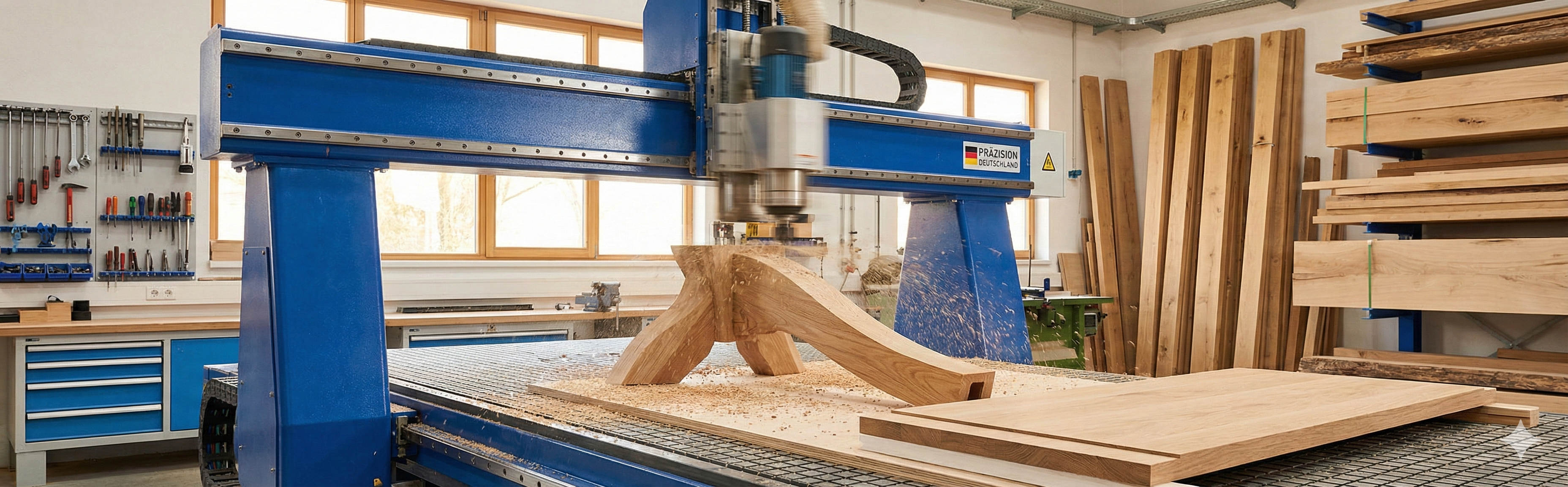
Woodworking
From furniture to staircases: milling wood with gantry milling machines Made in Germany
Wood is the material gantry milling machines are best suited to by design: large clamping surfaces, long travel ranges and spindle speeds that match the soft cutting conditions of solid wood and wood-based panels. All BZT series machine solid wood, MDF, multiplex, plywood and glued laminated panels — from cutting full-size boards to carcass joints and front milling through to reliefs and 3D engravings. In practice, the right series depends less on the material than on the format: the usable clamping surface, the Z travel required and whether you work in single-shift operation or series production. Two further points have a greater effect with wood than the machine itself: an adequately sized extraction system and the right choice of tool.
Recommended Machines
Matching CNC Milling Machines
Our customers most often use these series for this application


Materials
Typical Materials
Materials commonly machined for this application
Solid wood (hardwood & softwood)
MDF & chipboard
Multiplex & plywood
Glued laminated & furniture panels
Inspiration
Application Examples
Products made by our customers with BZT CNC milling machines



Videos
BZT CNC Milling Machines in Use
See our machines in action.
Knowledge
Practical Tips
Recommendations from our application engineers for the best results
Size the extraction first
Wood produces a greater volume of chips and dust than any other material. An undersized extraction system costs tool life, surface quality and a clear view of the process. A cyclone separator installed upstream keeps most of the chips out of the vacuum cleaner filter and considerably extends the intervals between filter changes.
Climb milling for clean visible edges
Edges milled in climb milling tear out less often on solid wood and veneered panels than with conventional milling. For visible edges, a finishing pass with a small depth of cut is worthwhile — it takes a few seconds per part and saves rework.
Choose the tool according to the grain
Spiral router bits with an upcut pull chips upwards and keep the groove clear, but tear the top edge. A downcut presses the top edge cleanly but clears chips less well. For edges that are visible on both sides, there are compression geometries.
Vacuum clamping for panel material
Full-size boards cannot be clamped economically with screw clamps. A vacuum table with a matching side channel blower holds large workpieces without interfering edges — crucial in nesting, when the toolpath runs across the entire board.
Calculate cutting data in advance instead of estimating
Spindle speed and feed depend on tool diameter, number of flutes and material. If you estimate them, you either work too slowly or burn out tools. The cutting data calculator in the knowledge centre provides starting values that can be fine-tuned in practice.
FAQ
Frequently Asked Questions
Which BZT series is suitable for woodworking?
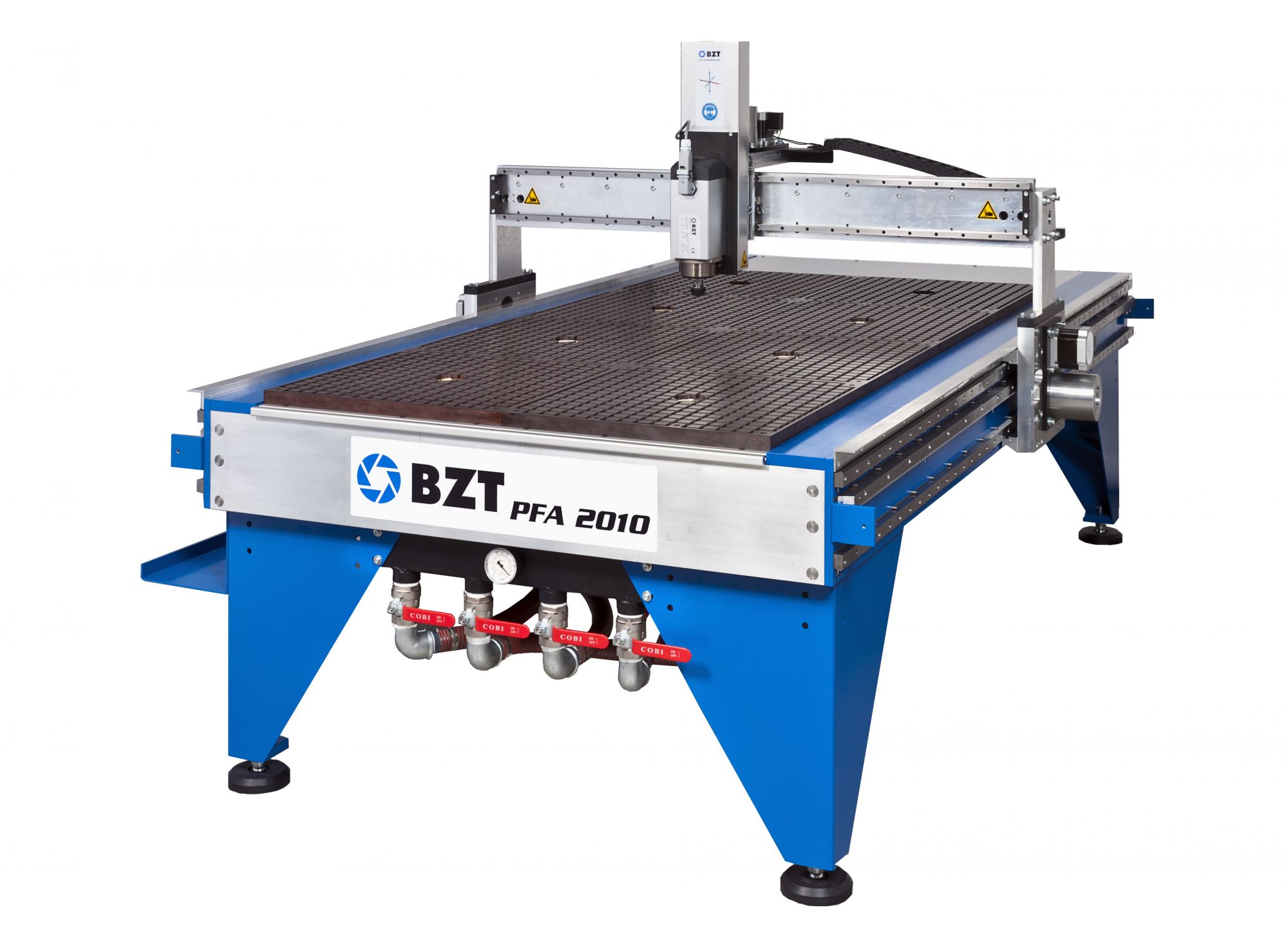
All BZT gantry mills machine wood and wood-based materials. The choice depends on the format: for workshop operation with full-size boards, the larger clamping surfaces of the PFU series are common; for smaller parts and sample making, more compact series are sufficient. Our application engineers will help you find the right match.
Which BZT milling machine takes a full 2500 × 1250 mm board?
For this, the machine needs a clamping surface of at least 1250 × 2500 mm. According to the data sheet, this applies to the PFU 2515-G and the PFH 2515-G, each with 1500 × 2500 mm, and to the larger PFH models such as the PFH 3020-G or the PFH 4025-G. Whether the board can be machined completely in one set-up also depends on travel, tool and equipment. On the PFH, the Y travel becomes shorter with extraction or a tool changer; in that case the data sheet recommends the next size up.
Is a gantry mill sufficient for staircase building?
For stringers, risers and treads, the decisive factors are the usable clamping surface and the Z travel, not the hardness of the material. With long stringers, you should also check whether the workpiece can be machined in one set-up or has to be repositioned.
Can I engrave wood with a CNC milling machine?
Yes. For engravings and reliefs in wood, high spindle speeds and a fine resolution of the path control are decisive. 3D reliefs and lettering are among the most common applications in woodworking.
What extraction capacity do I need for milling wood?
That depends on spindle power, tool diameter and material removal. As a guideline, the extraction system must capture the chips where they are produced, not further away in the machine area. A cyclone separator in front of the vacuum cleaner considerably reduces the load on the filter.
Are the machines also suitable for series production in wood?
Yes — the limiting factors here are traverse speed, rigidity and workpiece clamping. In continuous series operation, vacuum clamping and an adequately sized extraction system are more important than additional spindle power.
Individual Consultation for Your Project
Our application engineers will be glad to help you choose the right CNC milling machine for your requirements.