

The question of the best CNC gantry milling machine in 2026 cannot be answered with a single model. A machine that excels in the education sector is unsuitable for series production of aluminium parts, and vice versa. What matters is the material, workpiece size, planned utilisation and budget. This guide sorts the most important categories and names specific models that have proven themselves in practice, both from the portfolio of BZT Maschinenbau and from competitors such as Stepcraft, Sorotec or CNC-Step.
We concentrate on CNC gantry milling machines for professional use: machines with a stable machine bed, precise mechanics and a controller that does more than basic hobby electronics. If you are looking for a low-cost hobby solution under €1,000, you are in the wrong place in this comparison. If you are looking for a machine that works every day and lasts for decades, you will find orientation here.
Selection Criteria: What Makes a Good CNC Gantry Milling Machine
Before we compare specific models, it is worth looking at the six central criteria by which the quality and suitability of a CNC gantry milling machine can be measured. Anyone who understands these can assess data sheets realistically and see through marketing claims.
One of these claims deserves a closer look: what “Made in Germany” actually means for CNC milling machines, and how to recognise genuine depth of manufacturing, is explained in the guide CNC Milling Machine Made in Germany: What Is Behind It.
1. Rigidity and machine bed. Mechanical rigidity determines which cutting forces the machine can absorb without deformation. Welded steel frames, aluminium profile constructions with heavy-duty cross-sections or mineral cast beds belong to the professional class. Thin aluminium profiles from the model-making sector are usable for wood, but fail with aluminium.
2. Drive technology. Stepper motors with encoder feedback or servo motors determine acceleration, feed rate and repeatability. Ball screws are clearly superior to trapezoidal lead screws in rigidity and low backlash. Linear guides with profiled rails beat round-shaft constructions as soon as loads or speeds increase.
3. Spindle. The HF spindle is the heart of the machine. Speed range, torque, cooling (air or water) and tool holder (ER20, ER25, ER32, HSK, ISO) must match the planned application. A 1.5 kW spindle is too weak for milling aluminium, and a 5.5 kW spindle with HSK63 is oversized for pure wood.
4. Controller. The CNC controller connects the mechanics and CAM. Simultaneous axis interpolation, look-ahead, tool breakage detection, automatic tool changer and interfaces to post-processors determine productivity. WinPC-NC, UCCNC, Mach3 and Acorn dominate the mid-market; in the industrial sector Beckhoff or Siemens are used.
5. Working area and travel range. The travel ranges in X, Y and Z must match the largest planned workpiece size, with a reserve. The clearance height (Z passage) is often more important than the pure Z stroke: a kitchen front does not need 250 mm of Z stroke, but it does need 200 mm of free clearance height so that clamping does not become a chore.
6. Service, spare parts and proximity to the manufacturer. A machine works for 10 to 20 years. During this time, maintenance, software updates and occasional repairs are required. Manufacturers with their own production in Germany, transparent spare parts and accessible service are clearly superior to Asian importers or pure resellers.
CNC Gantry Milling Machines 2026 at a Glance
The following table assigns typical fields of application to the suitable BZT series and market alternatives. The prices given are guide values for standard configurations; exact prices depend on travel range, spindle choice and accessories.
| Category | BZT recommendation | Alternatives | X travel range | Materials | Price range (guide value) |
|---|---|---|---|---|---|
| Hobby & entry level | PFI, PFK | Stepcraft D.420 / D.600, Sorotec Compact Line | 300–720 mm | Wood, plastic, soft metals | approx. €3,000–6,000 |
| Joinery / wood workshop | PF, PFE | Stepcraft Q-Series, Sorotec Basic Line | 600–1510 mm | Wood, plastic, soft metals | approx. €8,000–18,000 |
| Sign making | PFA | Sorotec PRO Line, CNC-Step High-Z S-Series | 1010–1510 mm | Wood, plastic, aluminium, composites | approx. €12,000–22,000 |
| Aluminium professional | PFE, PFU | CNC-Step T-Rex, Sorotec PRO Line | 1010–2010 mm | Wood, aluminium, non-ferrous metals | approx. €18,000–35,000 |
| Series production | PFJ, PFU-S | CNC-Step RaptorX, industrial imports | 1010–2510 mm | Aluminium, non-ferrous metals, steel (light) | approx. €25,000–50,000 |
| Industry / XXL | PFH, PFG-S, PFL | Reichenbacher, Felder Format-4 | 2020–8020 mm | All, including steel, titanium, composites | from €50,000 |
This overview does not replace individual advice, but it shows that the step from hobby to industry is not linear. Between a €4,000 entry-level machine and a €60,000 industrial milling machine lie worlds in mechanics, controller and load capacity.
1. Best CNC Machine for Beginners and Education
For vocational schools, maker spaces, model makers and hobbyists with professional ambitions, three criteria count: a compact footprint, simple operation and a price in the low four-figure range. The BZT PFI is a benchtop mill with minimal space requirements and travel ranges from 300 mm, ideal for the training workshop or the model maker who machines wood, plastic and occasionally soft metal.
One step above ranks the BZT PFK with travel ranges up to 720 x 420 x 160 mm. It covers most hobby applications, but is already robust enough for occasional commercial jobs, such as smaller furniture parts, model-making milled parts or prototype tooling.
On the Stepcraft side, the D.420 (€899) and D.600 (approx. €1,500) as well as the M-Series (from €3,400) compete in this segment. Stepcraft scores with a large community, an academy and plug-&-play modules for 3D printing or laser. What Stepcraft lacks compared with the BZT PFK class is the mechanical robustness for extended aluminium machining. This is a result of the design and cannot be resolved by any surcharge.
Recommendation: If you are looking for a pure learning machine, Stepcraft is the cheaper way in. If you want a machine from the start that does not have to be replaced in two years but stays in the business as a second machine, you are better served with the BZT PFI or PFK.
2. Best CNC Machine for the Joinery Workshop
Joinery and carpentry workshops primarily process solid wood, panel materials (MDF, plywood, coated chipboard) and plastics such as HPL or acrylic glass. Typical workpieces range from furniture parts to doors and interior fitting elements. Travel ranges from 1000 mm are mandatory here, and 1500 mm in the X direction makes sense.
The BZT PF series with travel ranges up to 1010 x 600 mm serves the more compact joinery workshop. If you mill larger workpieces, you turn to the PFE series which, with a Z stroke of up to 250 mm and an optional raised gantry, is also suitable for 3D machining in thicker woods or composite panels.
For XXL formats, such as whole cabinet sides, kitchen fronts or stair strings, the BZT PFL offers a specialised solution. It is the large-format answer for joiners who cut and contour-mill panel material in the format 2500 x 1250 mm every day.
| Joinery application | Recommended BZT series | X/Y travel range | Recommended clearance height |
|---|---|---|---|
| Furniture parts, carcass elements | PF / PFE | 1010 x 600 mm | 160–200 mm |
| Doors, front panels | PFE 1300 / 1500 | 1310–1510 x 1010 mm | 200 mm |
| Kitchens, large panels | PFL | XXL format | 200–250 mm |
| 3D reliefs, carving | PFE with raised gantry | 1010–1510 mm | 250 mm |
3. Best CNC Machine for Sign Making
Sign makers mill acrylic glass, Dibond, Forex, PVC, ABS and wood, mostly as flat contour milling or engraving. Here, speed, feed rate and the vacuum table option matter more than pure Z stroke depth. The workpieces are typically flat panels, often in the format 1500 x 1000 mm or larger.
The BZT PFA series is designed for exactly this profile: travel ranges up to 1510 x 1010 mm, a compact Z axis with 160–200 mm stroke, designed for high feed rates in soft materials. A vacuum table is optionally available, which is decisive for flat workpieces without complex clamping fixtures.
As an alternative, Sorotec offers comparable sizes in the PRO Line, and CNC-Step the High-Z S-Series. Both are solid, but Sorotec also resells BZT machines, which speaks for the quality of the BZT design. Anyone buying here should go for direct purchase from the manufacturer to keep service costs and communication channels short.
For large-format sign making (lorry films, tarpaulins, XXL signs), the PFA is already at its upper limit, and the PFU or PFL come into view. A machine with 2000 mm X travel and a matching vacuum table solves the clamping problem for almost every sign-making application.
4. Best CNC Machine for Aluminium Machining
Aluminium is the litmus test for every CNC gantry milling machine. What still works with wood fails at the latest with an 8 mm aluminium plate and a roughing cutter. Three components decide: a sufficiently dimensioned spindle (at least 2.2 kW, ideally 4 kW), a water-cooled HF spindle with torque reserve and a rigid machine bed.
The BZT PFE is the entry class for serious aluminium machining. With profiled linear guides, ball screws and a 4 kW spindle option, aluminium components up to 30 mm thick can be milled economically. For more demanding aluminium profiles with thicker material, the BZT PFU or the reinforced PFU-S variant is recommended.
The PFU-S uses heavier linear guides and a thicker machine bed. It is also approved for light steel, which makes it the ideal machine for workshops that mainly mill aluminium but occasionally have to machine steel or stainless steel parts, such as prototype tooling or fixtures.
| Aluminium application | Recommended BZT series | Spindle recommendation | Tool holder |
|---|---|---|---|
| Aluminium up to 10 mm, profiles | PFE | 2.2 kW water-cooled | ER20 / ER25 |
| Aluminium 10–30 mm, components | PFE / PFU | 4 kW water-cooled | ER25 / ER32 |
| Aluminium thick-walled, toolmaking | PFU-S | 4–5.5 kW | ISO30 / HSK |
| Aluminium + light steel | PFU-S / PFH | 5.5 kW | HSK63 |
CNC-Step offers direct competition in this segment with the T-Rex and RaptorX models, but without a public price list. Anyone comparing here should obtain parallel quotes and pay attention to comparable configurations. Especially for spindle, controller and commissioning, the inclusive services vary greatly.
5. Best CNC Machine for Series Production
Anyone milling the same parts in larger quantities calculates differently: tool change time, setup time and machine downtime feed directly into the unit costs. A machine without an automatic tool changer (ATC) is not a tool here but a bottleneck.
The BZT PFJ series is designed for series production: stable construction, spindles with automatic tool holding (HSK or ISO), a tool magazine with 8–16 positions and an open-interface controller for connection to MES or ERP systems. Travel ranges up to 1010 x 1010 mm cover most small and medium-sized part production.
For larger workpieces in series, the PFU-S steps in with identical automation depth, but with travel ranges up to 3020 x 2010 mm. Applications from the furniture fittings, electrical engineering or mechanical engineering environment often run here.
Competition in series production comes rather from the classic industrial sector (Reichenbacher, Holzma, Felder). These manufacturers offer more extensive automation in some cases, but are priced above the BZT models. For workshops balancing between one-off and small-series production, the PFJ is the most economical middle-way solution.
6. Best CNC Machine for Industry and Large Format
Different rules apply in the industrial large-format segment. Machines are anchored on foundations and need compressed air, coolant supply and 32 A or 63 A three-phase connections. The controller communicates with post-processors from SolidCAM, Mastercam or hyperMILL. Operating staff are trained, and maintenance is carried out by service technicians.
The BZT PFH series covers the industrial mid-market with travel ranges up to 6020 x 3020 x 500 mm and Bosch Rexroth linear guides. It mills aluminium, steel, titanium and composites and is typically used in tool and mould making, in pattern milling or by specialised contract manufacturers.
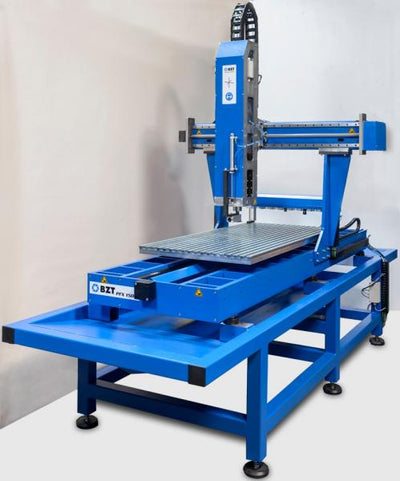
For XXL requirements, such as aircraft components, formwork patterns or large tools, the PFG-S comes into play with travel ranges up to 8020 x 3020 mm. The PFX rounds off the industrial portfolio with a high-precision focus for HSC machining.
In this segment BZT competes with classic machine tool manufacturers such as DMG MORI, Reichenbacher or Burkhardt+Weber. BZT is clearly positioned below them on price without compromising on the precision of standard applications. The decisive question here is whether special industrial requirements (coolant management, full enclosure, multi-spindle heads) should be part of the scope of delivery.
Price Range: What Does a Professional CNC Gantry Milling Machine Cost?
The price range for CNC gantry milling machines is enormous, from €3,000 for the benchtop mill to €250,000 for the fully equipped industrial system. Four classes can be roughly distinguished, each with its own inclusive services.
| Class | Price range (guide value) | Typical configuration | Examples |
|---|---|---|---|
| Entry | €3,000–6,000 | Stepper motors, 1.5 kW spindle, basic controller | BZT PFI, PFK, Stepcraft M.1000 |
| Workshop | €8,000–20,000 | Encoder stepper motors, 2.2–4 kW spindle, profiled linear guides | BZT PF, PFE, PFA |
| Professional | €20,000–50,000 | Servo motors, 4–5.5 kW spindle, ATC, vacuum table | BZT PFU, PFU-S, PFJ |
| Industry | from €50,000 | Industrial controller, complete equipment, commissioning included | BZT PFH, PFG-S, PFX |
What is often not included in the price: commissioning on site, training of operating staff, CAM software, initial equipment with cutters and clamping devices, dust extraction system. Anyone calculating honestly adds 10–20% of additional costs to every machine price for full production capability.
Another factor: delivery time. For German manufacturers with their own production, typical delivery times are between 8 and 16 weeks, depending on configuration and capacity utilisation. Stock items in under 4 weeks are the exception, and beyond 24 weeks you should become sceptical during selection.
Practical Checklist: How to Find the Right Machine
Before you enquire about a specific machine, a structured preliminary check is worthwhile. The following points should be clarified to make the consultation efficient:
- Largest planned workpiece: Length x width x height in millimetres
- Main material: Wood, aluminium, steel, composite, plastic?
- Maximum material thickness: What component thickness will be milled?
- Utilisation: Hours per day, days per week
- Accuracy: What tolerance does the component require? (±0.1 mm, ±0.05 mm, better?)
- Installation space: Available floor area and hall height
- Power connection: 230 V, 16 A, 32 A three-phase?
- Budget: Investment volume incl. accessories and commissioning
- Interfaces: Which CAM is used? Post-processor requirements?
With these answers, you can determine not only the machine but also the right CNC controller and spindle variant. An overview of all series with detailed specifications can be found on the series comparison page: travel ranges, materials and target groups are listed there in a structured way for each series.
Frequently Asked Questions
Is a kit or a ready-built machine worthwhile?
Kits save 15–25% on purchase, but you invest 40–80 hours of assembly time and bear the risk of assembly errors. For makers and technical tinkerers, this is an attractive learning path. For commercial users who need to work productively straight away, the ready-built machine with factory commissioning and guarantee is the better route. BZT offers both options. The decision should depend on the availability of time and mechanical prior knowledge, not only on price.
Can I upgrade an entry-level CNC machine later?
To a limited extent. Spindle upgrades, controller changes and software updates are easily possible with BZT machines. The mechanics themselves (machine bed, linear guides, drives) cannot be sensibly converted. Anyone who is foreseeably switching from wood to aluminium should therefore choose the next higher class straight away, instead of investing twice.
How long does a professional CNC gantry milling machine last?
With BZT machines, a service life of 15–20 years is realistic, and longer with careful maintenance. Wear parts are linear guides (after 8000–12,000 operating hours), ball screws (after 10,000+ hours) and spindle bearings. Controller electronics are typically modernised after 8–10 years. A BZT machine delivered in 1995 is still running today, with a retrofitted controller and a new spindle.
What delivery time does a German CNC gantry milling machine have?
Every machine is built to order. We will gladly tell you the current delivery time for your configuration by phone or on enquiry. Special configurations (oversized travel ranges, special spindle combinations, customer-specific enclosures) extend the delivery time. Compared with Asian imports, this can take longer, but we deliver with German final acceptance, CE conformity and personal commissioning.
Which manufacturer offers the best service?
A blanket answer would not be credible. Important indicators: own production in the country (not a pure sales company), a service telephone line with technician availability, transparent spare parts supply for at least 10 years after a model change, and remote diagnostics capability. BZT Maschinenbau meets these points as a German manufacturer with its own production in Leopoldshöhe since 2006. The same applies to CNC-Step and Haase in the industrial segment.
Conclusion and Advice
The best CNC gantry milling machine in 2026 is the one that fits your specific application, your budget and your capacity utilisation. Hobby users and educational institutions are very well advised with the PFI or PFK. Joinery workshops find in the PFE the all-purpose machine, sign makers in the PFA. Anyone who takes aluminium seriously chooses the PFU or PFU-S; series producers the PFJ. Industry and XXL format remain reserved for the PFH, PFG-S and PFL.
A complete overview of all available CNC gantry milling machines can be found in our shop. For choosing the right configuration, we recommend a personal conversation: our technicians advise on a product-neutral basis and would rather place one machine fewer, but the right one, in your workshop. Talk to us directly: we usually reply within one working day.



0 comments