
“Made in Germany” appears on many machines, but the term is not a protected seal that an authority checks and awards. Between a machine that is designed, machined and assembled entirely in Germany and a machine whose imported assemblies are merely put together here, there is a considerable difference, even though both may advertise with the same label. In this article we explain what lies behind the term, how you can recognise genuine manufacturing depth and which questions you should ask a manufacturer before buying a CNC milling machine.
The Key Points in Brief
- “Made in Germany” is not a certified designation with a fixed awarding body. The yardstick is the competition-law ban on misleading advertising: the essential, quality-determining manufacturing steps must take place in Germany.
- What matters is manufacturing depth, that is, which steps (design, machining, assembly, quality inspection) a manufacturer actually carries out itself, not just final assembly.
- Supplied components from specialists (such as linear guides or sensors) are usual in the industry and no contradiction of “Made in Germany”. Their origin should, however, be transparent.
- For buyers, what counts in everyday use is above all: spare parts supply even after years, accessible service in German, complete documentation with CE conformity, and the ability to adapt the machine to your own application.
- Imported machines are not generally worse. Apply the same criteria: who supplies spare parts, who provides support, who is responsible for conformity in the EU?
What does “Made in Germany” mean for machines?
The indication of origin goes back to a British trade law of the 19th century that was intended to mark imported goods, and over the decades it developed into a mark of quality. Legally, “Made in Germany” is still not protected as a seal: there is no central body that checks, awards or withdraws the designation, and no legally defined value-added ratio.
The yardstick comes instead from competition law. Under the ban on misleading advertising, a manufacturer may advertise with “Made in Germany” if the essential, quality-determining manufacturing steps take place in Germany. What “essential” means is for case law to clarify in each individual case: a mere final inspection or the fitting of a rating plate is not enough.
In practice, a broad spectrum exists under the same label: from the manufacturer that machines frames and mechanical components itself and builds the complete machine in its own factory, to the supplier that imports largely prefabricated assemblies and assembles and tests them in Germany. Both can be permissible in individual cases, but for you as a buyer it makes a difference in day-to-day operation.
Manufacturing Depth vs. Final Assembly: The Decisive Difference
Manufacturing depth describes what share of the value creation a manufacturer contributes itself: does it design the machine itself? Does it machine frames, gantries and mechanical components in-house? Does it assemble and test every machine itself? Or is its own contribution limited to putting together bought-in assemblies?
For CNC gantry mills this question is relevant for several reasons:
- Quality control: whoever makes the mechanical components themselves controls dimensional accuracy and fits along the whole chain, and can correct deviations before the machine is delivered.
- Spare parts: a manufacturer with its own production can also remanufacture mechanical parts for older machines. Anyone who only assembles depends on the delivery and model policy of their upstream supplier.
- Adaptability: special travel ranges, customer-specific workholding solutions or integrated dust extraction require the manufacturer to be able to intervene in the design. With pure final assembly this is hardly possible.
- Know-how in support: anyone who has developed a machine themselves knows it down to the last detail. This pays off when a problem has to be diagnosed years later.
An important point for perspective: no machine builder makes everything itself, which would be neither sensible nor usual. Linear guides, ball screws, sensors or pneumatics come from specialised suppliers across the industry. This is no contradiction of “Made in Germany”. What matters is who designs the machine, machines the load-bearing components, builds it and tests it, and whether the manufacturer discloses the origin of its components.
What Buyers Should Look For
1. Ask Specifically About Manufacturing Depth
Do not ask “Is the machine Made in Germany?” but: which steps take place where? Who designs, who machines the frame, who assembles, who tests? A manufacturer with genuine production can answer this without hesitation and, if in doubt, will also show you its production.
2. Spare Parts Supply for Older Machines as Well
A CNC milling machine is a long-term investment. Clarify whether the manufacturer supplies spare parts for older machine generations too, and how quickly. With manufacturers that have their own production, mechanical parts can be remanufactured if necessary; with imported goods, supply depends on the supply chain.
3. Service and Accessibility
Check whom you can reach in the event of a fault: a specialist workshop with a direct line to development, or a hotline with no access to the actual manufacturer? Useful criteria are telephone accessibility during German business hours, remote maintenance, instruction at handover, and the option of viewing the machine on site before purchase and carrying out test cuts.
4. Documentation and Conformity
For machines in the EU, CE conformity and operating instructions in the national language are mandatory. Make sure the documentation is complete and comprehensible, including circuit diagrams and information on maintenance and lubrication. Incomplete or machine-translated documents are a warning sign, regardless of the origin label.
5. Adaptability to Your Application
Workshops rarely have standard requirements. Clarify whether the manufacturer can adapt travel ranges, workholding solutions, dust extraction or spindle configuration to your production. This is exactly where the difference between a manufacturer that designs and a pure assembly operation is most apparent.
6. Site Visit and References
The simplest practical test: visit the manufacturer. Anyone with their own production will show it. A showroom with demo machines, the option of a test cut in your material and traceable references from your industry say more than any label.
And Imported Machines? An Objective Assessment
Imported CNC milling machines have their place in the market, and especially in the hobby sector and on a limited budget they can be a sensible choice. The point is not to write off imported goods across the board, but to apply the same criteria: who will supply spare parts in five years? Who answers technical questions, in what language and in what time zone? And who is responsible for CE conformity in the EU? Is there a responsible economic operator (manufacturer, authorised representative or importer) you can reach if it comes to it?
Reputable importers answer these questions transparently and maintain their own spare parts stocks and support structures. It becomes critical with direct imports without a responsible contact in the EU: here warranty, conformity and spare parts supply often remain with the buyer. For commercial use, where machine downtime costs money, the question of service and parts supply should therefore carry at least as much weight as the purchase price.
Example BZT: In-House Manufacturing in East Westphalia
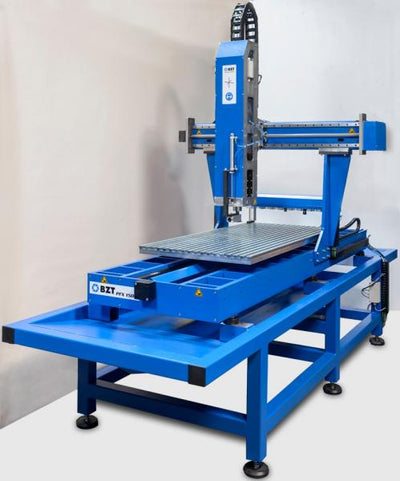
BZT Maschinenbau shows what manufacturing in Germany can look like in concrete terms: the owner-managed family business, based in Leopoldshöhe near Bielefeld, developed its first own CNC gantry mill in 2005 and was founded as a GmbH in 2006. Its roots lie in a machining company from the 1990s. Today BZT employs more than 40 people and has delivered more than 4,100 CNC machines to 62 countries.
| Criterion | Implementation at BZT |
|---|---|
| Manufacturing depth | Design, CNC milling, CNC turning, grinding, welding and final assembly in its own factory in Leopoldshöhe |
| Components | Supplied parts from branded manufacturers, including Bosch Rexroth (linear guides, ball screws), Festo (pneumatics), Sick (sensors), igus (energy chains) |
| Quality inspection | Multi-stage before delivery: dimensional accuracy check, functional test of all axes, trial run under load |
| Adaptability | Individual configuration for each machine, from special travel ranges through customer-specific workholding solutions to integrated extraction systems |
| Service | Personal advice, showroom with demo machines and test cuts, instruction and training, remote maintenance, spare parts supply for older models as well |
| Range | Over 100 machine variants in 17 series, from the entry-level milling machine to the large industrial gantry machine |
With more than 30 years of machining experience in-house, the range of CNC gantry milling machines Made in Germany from BZT covers a broad spectrum of applications. You will find an overview of all series, including the machine finder and a comparison table with the technical data from the current data sheets, in the CNC machines category. You can read more about the company history, the production and the location on the About BZT Maschinenbau page.
Checklist for the Conversation with the Manufacturer
- Which manufacturing steps take place in-house: design, machining, assembly, inspection?
- Can I visit the production and carry out a test cut with my material?
- Which components come from which suppliers?
- How long and how quickly are spare parts delivered, for older machines as well?
- Whom do I reach in the event of a fault, and is there remote maintenance?
- Is the documentation complete: CE declaration of conformity, operating instructions in German, circuit diagrams?
- Can the machine be adapted to my application (travel ranges, workholding, dust extraction, spindle)?
How to get from these criteria to a specific machine choice is described in detail in the Buying Guide for CNC Gantry Milling Machines and in the guide Buying a CNC Milling Machine: What Really Matters. For questions about a specific application, personal advice will help.
Frequently Asked Questions
Is “Made in Germany” a protected seal?
No. There is no authority or certification body that checks and awards “Made in Germany”, and no legally defined value-added ratio. The yardstick is the competition-law ban on misleading advertising: the designation is permissible if the essential, quality-determining manufacturing steps take place in Germany. What this means in an individual case is for case law to clarify: a mere final inspection is not enough.
How can I tell how much a CNC manufacturer really makes itself?
Ask specifically about the individual manufacturing steps: who designs the machine, who machines the frame and mechanical components, who assembles and tests? Ask for a factory tour: a manufacturer with its own production is usually glad to show it. The question of whether mechanical spare parts can be remanufactured for older machines also gives an indication of the actual manufacturing depth.
Are imported CNC milling machines generally worse?
No, that cannot be said across the board. Especially in the hobby sector, imported machines can be a sensible choice. The decisive criteria are the same as for any manufacturer: spare parts supply over the years, accessible technical support, complete documentation and a responsible economic operator in the EU (manufacturer, authorised representative or importer) who is answerable for CE conformity. For commercial use, service and parts supply weigh particularly heavily, because machine downtime costs money.
Does BZT manufacture its CNC milling machines in Germany?
Yes. BZT Maschinenbau builds its CNC gantry mills in its own factory in Leopoldshöhe near Bielefeld, from design through CNC milling, CNC turning, grinding and welding to final assembly and quality inspection. Supplied components such as linear guides and ball screws come from branded manufacturers such as Bosch Rexroth. Since the first own gantry mill in 2005, more than 4,100 machines have been delivered to 62 countries.
Why do German manufacturers use components from suppliers?
Because it makes technical sense: linear guides, ball screws, sensors or pneumatics are highly specialised products that suppliers such as Bosch Rexroth, Sick or Festo make in large series with corresponding manufacturing experience. No machine builder makes all components itself. What counts for classification as “Made in Germany” is who designs the machine, machines the load-bearing components, assembles and tests it, not whether individual standard parts are bought in.


0 comments