

The decision between a CNC kit and a fully assembled gantry milling machine is about more than price. It affects your workshop time, your technical self-image and, in the end, how quickly you can work productively with the machine. At first glance the kit noticeably saves money, but the real value is decided by factors that do not appear in the data sheet: How much time do you have? How confident are you with mechanics and electronics? How important is it to you that the machine is running from day one?
This article clears up sweeping generalisations. You will learn what is really in a typical kit, which tools you need, how long assembly realistically takes and for whom building it yourself is worthwhile, or not. Anyone looking for a clear overview of the entire portfolio will find it in our series overview.
What is in a CNC kit?
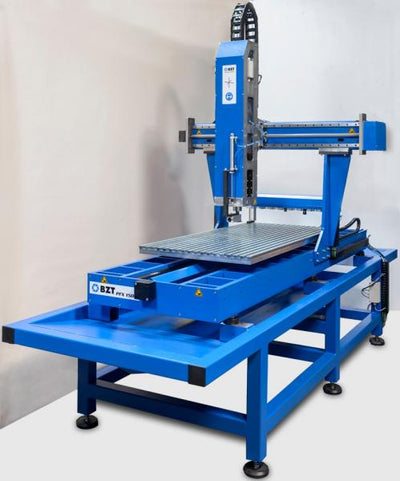
A professional CNC kit is not a loose bag of screws but a fully planned component package that you assemble yourself into a working machine. At BZT, the scope of delivery is sized so that all you additionally need is standard tools and some workshop space. Specifically, a typical BZT kit contains the following main groups:
- Frame profiles made of extruded aluminium: Already cut to size, prepared with holes and threads. These form the machine table, gantry and Z axis.
- Linear guides: Profile rail guides with guide carriages, pre-assembled on the respective axis supports or as a separate set.
- Ball screws with fixed bearings: Preloaded screw nuts, bearing blocks, shaft couplings. Already cut to the right length.
- Drive motors: Usually stepper motors with matching drivers, depending on the configuration also servo motors.
- Controller: A fully wired BZT controller with power supplies, drivers and control electronics in the control cabinet.
- Milling spindle: Either an HF spindle with frequency inverter or a router motor with commutator, depending on the application.
- Cabling and energy chains: Pre-assembled cables, energy chains, connectors and limit switches.
- Assembly instructions and CAD drawings: Step-by-step documentation, technical drawings, circuit diagrams.
The decisive difference from a mismatched DIY build: All components are matched to each other, the mechanical geometry fits and the electronics are already parameterised. So you need neither saw profiles nor size motors.
Advantages of a Kit
The kit is not the right choice for everyone, but where it fits, it clearly plays to its strengths. These points speak in favour of building it yourself:
- Cost advantage: You save the manufacturer’s assembly and commissioning time. On a medium-sized machine, depending on the model, that amounts to several hundred to more than a thousand euros.
- Learning effect: In the end you know every screw, every cable connection and every adjustment. This pays off many times over later in maintenance, expansion and troubleshooting.
- Modularity: You understand which component has which task. Later upgrades, such as swapping the spindle for a more powerful version, become routine rather than a service case.
- Individual customisation: You can make small detail decisions during assembly: Where do you route the cables? Which clamping solution suits your table? Which dust shoe do you fit, and how?
- Pride and identification: A machine you have built yourself is your machine. Anyone who has once aligned a 1.5-metre gantry themselves treats the milling machine differently.
- Better shipping logistics: Kits can be packed more compactly and more securely than pre-assembled machines. Transport damage occurs less often because the critical assemblies are secured individually.
Disadvantages and Pitfalls
The downsides deserve to be put on the table just as honestly. A kit is not a piece of furniture from a furniture store: it demands discipline and patience.
- Time required: 30 to 80 hours of pure assembly time are realistic. If you also have other work in between, it takes several weekends.
- Tool and workshop requirements: Without a torque wrench, spirit level, dial indicator and enough space, assembly becomes a test of patience.
- Knowledge requirements: Basic knowledge of mechanics, electronics and control technology is necessary. Anyone who has never wired a 230 V socket should get support.
- Sources of error: Jammed profiles, screws on the spindle nut tightened too firmly, swapped motor connections: every mistake costs time and, in the worst case, money.
- Limited warranty: The usual statutory warranty applies to components, but manufacturers understandably cannot give a guarantee on the assembly itself.
- Delayed start of production: If you urgently need to become productive, with a kit you are not waiting for the freight carrier but for the next free weekend.
Realistic Assembly Time: 30–80 Hours
A question we hear particularly often: “How long does assembly really take?” The honest answer is: It depends on the machine size, your experience and your care. For a compact machine such as a BZT PFK with 600 mm of travel, 30 to 40 hours is a realistic figure if you proceed systematically. Larger machines with more than a metre of travel are more likely to take 60 to 80 hours.
Important: These times refer to pure assembly. Research, delivery time, workshop preparation and software set-up come on top. Anyone who has a job alongside should allow four to eight weeks until the machine is milling productively.
Tools and Prerequisites
What has to be available in the workshop for assembly to succeed? The good news: You do not need an industrial workshop. A well-equipped hobby room is enough. However, you should have this basic equipment ready:
- Torque wrench in suitable ranges (typically 5–25 Nm and 10–100 Nm)
- Hex key set in metric sizes, ideally with a T-handle for repetitive work
- Spirit level or, better, a machine level for aligning the table
- Dial indicator with magnetic stand for aligning the linear guides
- Multimeter for checking electrical connections
- Crimping pliers and wire-end ferrules for clean terminal connections
- Sturdy workbench or machine foundation with enough space around it
- 230 V connection with RCD protection, depending on the controller variant also three-phase power
- Good lighting: sounds trivial, but is worth its weight in gold when wiring
Anyone operating an HF spindle should also think about the suitable dust extraction. With larger machines, a crane or at least a helper for lifting the gantry is also worthwhile.
Kit vs. Assembled Machine Compared
The following overview compares the most important decision criteria. It helps you to make an honest self-assessment.
| Criterion | CNC kit | Assembled machine |
|---|---|---|
| Price | 10–25% cheaper | Surcharge for assembly and commissioning |
| Assembly time | 30–80 hours of your own work | A few hours of installation |
| Learning effect | Very high, full knowledge of the machine | Low, only through use |
| Guarantee | On components, not on assembly | Full guarantee, including function |
| Commissioning effort | Independent, with instructions | Pre-tested at the factory |
| Resale value | Depends on build quality | Solid, with history |
| Customisability | High, possible during assembly | Standardised, modifications more involved |
| Risk of errors | Depends on self-assembly | Minimal, tested at the factory |
| Time to first chip | Weeks | Days |
Who is a kit worthwhile for?
Not every buyer benefits from a kit. In other words: If you recognise yourself in several of the following points, you are a good candidate.
For workshops that work purely productively and have to process orders every day, the assembled machine is generally the better route. Here every day of downtime counts, and the few euros saved are quickly eaten up by the later start of production. So anyone who calculates commercially with a clear hourly rate should not underestimate the real value of their own time.
BZT kits: which models are available?
BZT offers selected series both as a kit and as a fully assembled machine. You can see which variants are currently available in our overview of CNC kits. The compact entry-level series and the mid-range workshop machines are particularly popular, because here self-assembly can be planned well in relation to the machine size.
Anyone who is not yet sure which series suits their application will find initial guidance in our main categories: all CNC gantry milling machines at a glance, or specifically the compact BZT PFK series for small workshops and the even more compact BZT PFI as a benchtop mill. For larger tasks, we recommend a direct look at the series comparison table, in which you can compare travel, materials and target groups of all 17 series.
By the way: Even if you decide on the kit, you do not have to accept every component from the kit. In principle, you can order the machine with a more powerful spindle or with an extended controller. Just talk to us beforehand; most desired configurations can be accommodated.
Frequently Asked Questions
How long does it take to assemble a CNC kit?
30 to 80 hours of pure assembly time are realistic, depending on machine size and previous experience. Compact machines such as the PFK are at the lower end, larger models with more than a metre of travel tend to be at the upper end. Spread over evenings and weekends, this results in a period of four to eight weeks until the first productive use.
What prior knowledge do I need?
You should be able to handle basic hand tools, use a multimeter and read a circuit diagram. Previous experience with 230 V electrics is helpful; with larger machines with three-phase control, you should either be well versed or bring in an electrician. Mechanical understanding does no harm, because you have to align linear guides and ball screws precisely.
Can I replace components later?
Yes, and that is one of the great advantages of the kit. Because you know the assembly yourself, later upgrades such as a more powerful HF spindle, a new controller or replacing the drivers are possible without difficulty. Changing from stepper to servo motor can also be carried out retrospectively on most series.
Is there a guarantee on a kit?
The statutory warranty applies to the individual components, as with the purchase of any other goods. The manufacturer understandably cannot give a guarantee on the assembly itself, because it is outside its control. Therefore pay attention to clean workmanship and torque specifications: this protects not only the guarantee but also your machine.
Will I get help with assembly?
Yes. Every BZT kit comes with detailed assembly instructions with CAD drawings and circuit diagrams. If you have questions during assembly, you can reach our technical support by telephone or email. Anyone looking for a quicker start can ask us for advice via the contact form; often a 15-minute phone call is enough to clarify the first critical steps.
Are you still unsure whether a kit or an assembled machine suits your application? Talk to us. In a consultation we will work out travel, material, quantity and budget together, and you will receive an honest recommendation instead of a pure sales pitch. Straight to the consultation.



0 comments