

Sign making is one of the main applications for CNC milling machines. Whether illuminated letters, company signs, trade fair displays or shop window decoration: a CNC gantry milling machine is the indispensable tool for precise, reproducible and economical results.
In this practical guide you will learn which applications CNC enables in sign making, which materials and techniques are used, and which machine equipment you need for professional results.
Why CNC in Sign Making?
In the past, signs and letters were laboriously sawn, sanded and finished by hand. Today the CNC milling machine takes over this work with decisive advantages:
- Precision: Complex logos and lettering produced exactly to specification
- Reproducibility: Programmed once, produced identically as often as you like
- Speed: Hundreds of letters overnight: the machine works while you sleep
- Material efficiency: Nesting arranges many parts efficiently on one sheet
- Consistent quality: No part differs from another
Typical Applications in Sign Making
Signs and Signage Systems
From the simple house number to the complex wayfinding system, signs are the bread-and-butter business of sign making:
- Company signs: Exterior and interior signs with logo and lettering
- Directional signs and wayfinding systems: Uniform signage for office complexes, hospitals, trade fairs
- Information boards: Engraved information with long durability
- House numbers and door signs: Individual production in small quantities
- Memorial plaques: Engravings in metal or a stone look
Typical materials: Dibond (aluminium composite), PMMA (acrylic), brushed aluminium, rigid PVC foam, wood
3D Letters and Lettering
Three-dimensional letters are a highlight of any façade. With CNC you can produce:
- Profile letters: Made of acrylic or aluminium with milled contours
- Shadow-gap letters: Mounted at a distance from the wall for an elegant shadow
- Illuminated letters: With rear-lit or front-lit LED lighting
- Relief letters: Milled from solid for a massive look
- Metal letters: Made of aluminium, brass or stainless steel
Typical machining: Contour cut + 45° chamfer for light refraction + mounting groove on the back
Displays and Stands
The point of sale thrives on eye-catching presentations:
- POS displays: Product presentations at the point of sale
- Trade fair structures: Modular systems that can be assembled and dismantled quickly
- Shop window decoration: Seasonal decorations, brand staging
- Product stands: Custom holders for goods
- Counter displays: Compact presentation surfaces
Typical materials: Rigid PVC foam (Forex), acrylic, wood, corrugated cardboard (CNC-cut)
Decorations, Inlays and Wall Design
For interior design and exclusive design:
- Wall cladding: 3D panels with geometric patterns
- Inlay work: Different materials combined
- Ornaments: Classic or modern decorative patterns
- Acoustic panels: Perforated or slotted panels for sound absorption
Materials in Sign Making
The variety of materials is one of the reasons why CNC milling machines are so popular in the industry:
| Material | Properties | Typical application | Special features |
|---|---|---|---|
| PMMA (acrylic) | Transparent, glossy, polishable | Illuminated letters, refined signs | Edges can be flame-polished |
| Dibond | Aluminium composite, bend-resistant, weatherproof | Exterior signs, façade elements | Very dimensionally stable, easy to machine |
| Rigid PVC foam (Forex) | Light, low-cost, easy to machine | Displays, interior signs, trade fairs | Not UV-resistant for exterior use |
| Aluminium | Weatherproof, refined, durable | Exterior lettering, metal letters | Requires a stable machine |
| Wood/MDF | Natural, paintable, warm | Rustic signs, catering decoration | A wide range of surface treatments possible |
| HPL (laminate) | Extremely scratch-resistant, weatherproof | Permanent exterior signage | Special tools recommended |
| Polystyrene | Very light, low-cost | Temporary displays, decorations | For short-term applications |
Machining Techniques for Sign Making
Contour Cutting (2D)
The basic technique: letters, shapes and logos are cut out of the sheet. The parts are either held with small bridges (tabs) or fixed on a vacuum table.
Tools: Single-flute or two-flute end mills, 3–6 mm diameter
V-Carving (Engraving)
A V-shaped engraving cutter produces elegant lettering and details:
- Depth varies with width: narrow lines are shallower, wide ones deeper
- Ideal for a “hand-carved” look
- Excellent for notice signs and refined lettering
Tools: V-groove cutters with 60°, 90° or 120° point angle
3D Machining and Reliefs
For three-dimensional effects:
- Rounded letter edges
- Wave-shaped surfaces
- Relief images and logos
Tools: Ball nose end mills for finishing passes
Edge Machining and Chamfers
Milled chamfers give letters and signs depth:
- 45° chamfer: Classic for profile letters, refracts the light elegantly
- Rounding: Soft edges for a modern look
- Shadow gap: Groove on the back for spacers
Recommended Machine Equipment for Sign Making
Travel Ranges
Sign making often works with standard sheet formats. Your machine should cover at least one of these formats:
- Half sheet: 1250 x 2500 mm (very common)
- Full sheet: 2500 x 2500 mm or 3050 x 2050 mm
- Small format: 1000 x 1500 mm for one-off jobs
Vacuum Clamping
In sign making, a vacuum table is almost indispensable:
- Quick clamping of large sheets
- Clear milling path without obstructive clamps
- Easy sheet changes between jobs
- Zone switching for different part positions
Dust Extraction
Chips from acrylic and PVC are not only a nuisance, they can also become statically charged and stick to the workpiece. Good dust extraction is a must, ideally with antistatic equipment.
Spindle
For the typical sign-making materials, a spindle of 2–3 kW is often enough. More important than raw power is spindle speed flexibility:
- Acrylic: High spindle speed (18,000–24,000 rpm), moderate feed rate
- Aluminium: Medium spindle speed (10,000–15,000 rpm), lubrication recommended
- Wood: High spindle speed, high feed rate possible
BZT Recommendations for Sign Making
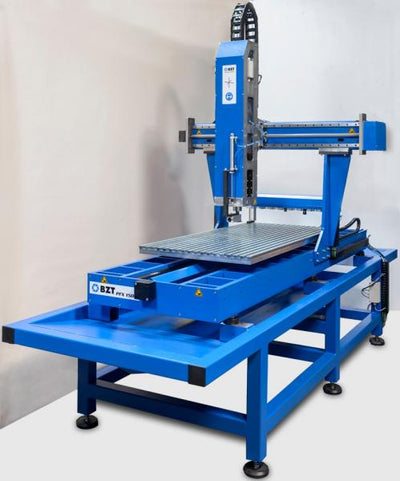
Our PFA series was developed specifically for sign making:
- Gantry design: Stable construction for large travel ranges
- Large formats available: Up to 2500 x 4000 mm working area
- Vacuum table option: Professional vacuum clamping with zone switching
- Optiscout compatibility: Optical registration mark detection for digital-print contour cutting
For smaller businesses or as an entry point, we also recommend the PFU and PFU-S series. They also offer the necessary travel ranges for half-sheet formats and stand out for their universal usability.
BZT tip: When choosing a machine, also pay attention to the table height: ergonomic working pays off quickly with daily sheet changes.
Practical Tips from Sign Making
Polishing Acrylic Edges
After milling, acrylic edges are matt. For a crystal-clear look there are three methods:
- Flame polishing: With a special hydrogen-oxygen torch, fast and effective
- Mechanical polishing: Polishing wheels and paste, time-consuming but reliable
- Solvent vapours: Chloroform or dichloromethane, only with experience and dust extraction.
Preparing Illuminated Letters
With illuminated letters, clever programming saves a lot of rework:
- Rear bridges: Milled-in bridges for LED strips
- Mounting groove: Groove for adhesive profile or screws
- Cable routing: Channels for the power supply
Using Protective Film
Acrylic and Dibond are often supplied with protective film. Mill through the film. This protects the surface from scratches and chips. The film is only peeled off after installation.
Nesting for Material Efficiency
With nesting software, you arrange many parts efficiently on one sheet. This saves material and time, especially for recurring jobs with many letters.
FAQ: Frequently Asked Questions About CNC in Sign Making
What minimum size should my machine have?
For professional sign making we recommend a travel range of at least 1250 x 2000 mm. This lets you machine the common half sheet (1250 x 2500 mm) and leaves reserves for larger individual parts.
Do I absolutely need a vacuum table?
Not necessarily, but it makes work much more efficient. Alternative: T-slot plate with strap clamps. That works, but it is more time-consuming when changing sheets.
Can I also mill aluminium with a sign-making CNC machine?
Yes, most machines for sign making can also machine aluminium. For regular aluminium work, make sure the machine is sufficiently rigid and, if necessary, use minimum quantity lubrication (MQL).
Conclusion: CNC and Sign Making, the Ideal Combination
CNC milling machines have transformed sign making. What used to be manual work is now done by the machine, more precisely, faster and reproducibly. As a sign maker, you can concentrate on what really counts: creative designs and satisfied customers.
With the right machine equipment (sufficient travel range, vacuum clamping and good dust extraction), you are equipped for all the demands of the industry.
More CNC Applications
Planning to get started with CNC-supported sign making? Our technical team is happy to advise you on the right machine configuration for your applications. Contact us, we look forward to your project.




0 comments