

Model making was one of the first areas where CNC milling found its way into the hobby sector, and it remains one of the most important applications today. Whether RC aircraft, ship models, cars or architectural models: a gantry mill raises quality considerably and makes possible projects that would be barely feasible by hand.
This guide shows you how to get the most out of your CNC machine for model-making projects, from choosing the material and the right tools to proven techniques such as stacked-layer fuselage construction.
Why CNC in model making?
The combination of precision and repeatability makes CNC milling the tool of choice for demanding model makers:
- Precision: Parts that fit and really do go together. No more manual corrections, no more frustrating fit problems.
- Repeatability: Produce identical parts in series. Ten wing ribs mean ten identical ribs, not almost the same.
- Complex shapes: Airfoils, fuselage formers, 3D contours: anything you can design on the computer can be made.
- Time savings: What used to take hours of manual work is milled in minutes. More time for the enjoyable aspects of model making.
- Documentation: Design once, reproduce at any time. Spare parts are no longer a problem.
Typical Model-Making Applications
Model Aircraft
Model aircraft building benefits particularly from CNC precision:
- Ribs and formers: Milled from plywood or balsa, identical and accurately fitting
- Motor mounts: Made from GRP or aluminium for high loads
- Servo trays: Accurately fitting cut-outs for exact positioning
- Landing gear mounts: Precisely made for safe landings
- Stacked-layer fuselages: Complex 3D shapes from stacked layers
BZT tip: For model aircraft builders, we recommend machines with at least 600 x 400 mm travel range so that even larger wing ribs can be produced in one piece.
Model Ships
From the historic galleon to the modern racing boat:
- Hull formers: Precise contours for classic frame-and-former construction
- Deck superstructures: With fine engraving and detailing
- Fittings: Made from brass or aluminium
- Planking templates: For even planking
- Railings and guardrails: Delicate parts made from thin material
RC Cars and Trucks
In RC motorsport, every gram and every tenth of a millimetre counts:
- Chassis plates: Made from carbon (CFRP) or GRP for maximum rigidity
- Mounts: Custom aluminium special parts
- Body mounts: Precision parts for an exact fit
- Shock towers: Custom-made upgrades
Architectural Models
For architects and property developers:
- Façade elements: With fine architectural details
- Terrain models: 3D-milled from rigid foam or MDF
- Structures: Made from various materials for a realistic representation
- Furnishing elements: True-to-scale furnishings
Materials in Model Making
| Material | Typical application | Special feature | Recommended cutter |
|---|---|---|---|
| Plywood (poplar, birch) | Ribs, formers, structural parts | Low-cost, light, stable | Solid carbide single-flute cutters, compression cutters |
| Balsa | Light structures, planking | Very soft, quick to mill | Sharp single-flute cutters, small depth of cut |
| MDF | Moulds, master patterns, templates | Homogeneous, easy to coat | Solid carbide single-flute cutters |
| GRP/CFRP (carbon) | High-load parts, chassis | Very dusty. Dust extraction is mandatory | Diamond-coated cutters |
| Aluminium | Landing gear, fittings, motor mounts | High precision possible | Solid carbide single-flute cutters for aluminium |
| Brass | Decorative parts, fittings, ship models | Elegant appearance, machines well | Solid carbide single-flute or two-flute cutters |
| Rigid foam (Styrodur) | Terrain models, master shapes | Light, quick to machine | Large cutters, high feed rates |
Tool Selection for Model Makers
Small Tools, Fine Details
Model making often uses small cutters (1–3 mm diameter). This calls for special attention:
- High spindle speeds: Small cutters need high spindle speeds (18,000–24,000 rpm)
- Small depth of cut: Maximum 50% of the diameter
- Good runout: The spindle must run precisely
- Quality tools: Solid carbide is worthwhile for small cutters
The Most Important Cutters for Model Makers
- Single-flute cutters, 2–3 mm: Universal for wood and plastic
- Compression cutters: For coated plywood, with clean edges on both sides
- 60° V-groove cutters: For engraving and lettering
- Ball nose end mills: For 3D contours and fillets
Clamping Thin Materials
Plywood and balsa are thin and delicate, so the right clamping method is decisive:
Vacuum Table
The preferred solution for sheet material:
- Fast workpiece changes
- No distortion from clamping pressure
- The entire surface is accessible
- Well suited to nesting (several parts on one sheet)
Double-Sided Adhesive Tape
The low-cost alternative:
- Use special tape for CNC applications
- Apply evenly, with no air bubbles
- Sufficient for light machining
Holding Tabs
Parts remain connected to the raw material by small tabs:
- CAM software can place tabs automatically
- Snip off or sand off after milling
- A secure method, even for small parts
Nesting for Efficiency
For many parts, the nesting function of the CAM software is worthwhile:
- Arrange parts efficiently on the material
- Minimise material waste, which matters with expensive plywood
- Save time through fewer material changes
- Use shared cutting lines where possible
BZT tip: Plan your projects completely before you mill. That way you can combine parts from different assemblies on the same sheet.
Special Case: Stacked-Layer Fuselages
A popular technique in model aircraft building: creating complex 3D fuselage shapes from layers glued on top of each other.
The Process
- Create the 3D model: CAD program with a slicing function (Fusion 360, FreeCAD)
- Slice into layers: Typically 3–6 mm layer thickness
- Mill the 2D contours: Each layer from plywood
- Glue the layers: Align carefully and press
- Rough shape: A stepped shape results
- Post-processing: Sand, fill, cover
Advantages
- Complex 3D shapes without true 3D machining
- Light but stable structures
- Possible even with simple machines
- Reproducible: replacement fuselages after crashes
Tips for Precise Slot Joints
Slot-and-tab joints are everywhere in model making. Here is how to get them right:
- Observe tolerances: 0.1–0.2 mm allowance for a clearance fit, 0 mm for an interference fit
- Wood glue: Plan slots slightly narrower (wood swells when glued)
- Test cuts: Always test on offcuts
- Cutter diameter: Inside corners are rounded, so plan relief cuts
Machining CFRP and GRP Correctly
Carbon fibre (CFRP) and glass fibre (GRP) require special measures:
- Dust extraction is mandatory: The dust is harmful to health
- Wear respiratory protection: FFP2 mask as a minimum
- Diamond-coated cutters: Longer tool life in abrasive material
- Avoid up-cut milling: Risk of delamination
- Compression cutters: Or downcut for a clean top edge
Recommended BZT Machines for Model Making
| Series | Strengths | Well suited for |
|---|---|---|
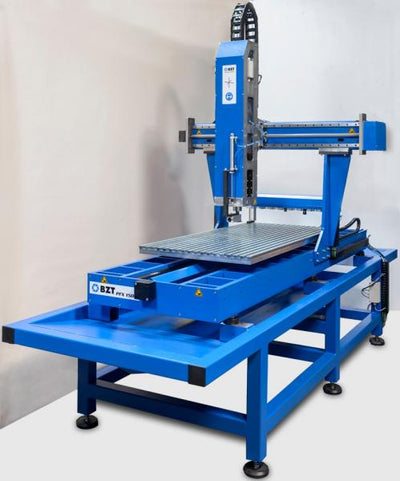
| PFK series | Compact, space-saving, precise | Smaller models, limited workshop |
| PF series | Flexible, proven technology | All-round model making, wood/plastic |
| PFE series | High precision, Bosch Rexroth | Demanding projects, including aluminium |
The typical model-making materials (wood, plywood, plastics) can be machined without problems on all BZT machines. For carbon and aluminium, we recommend the PFE series or higher.
FAQ: Frequently Asked Questions About CNC Model Making
What machine size do I need for model making?
That depends on your projects. For most model aircraft, a travel range of 600 x 400 mm is enough. Larger wing ribs or ship hulls require more. Bear in mind: a rib that is 50 cm long needs at least 500 mm of X travel plus a safety margin.
Can I do model making with a low-cost hobby CNC machine?
For simple wooden parts such as ribs and formers, yes. But as soon as you want to machine precise fits, aluminium or carbon, budget machines quickly reach their limits. The repeatability and stability of well-built machines pay off here.
Do I need a vacuum table for model making?
Not necessarily, but it makes many things easier. Especially for nesting projects with many small parts, a vacuum table saves an enormous amount of time. To get started, you can also work with adhesive tape and tabs.
Which software is suitable for model-making CAD?
For 2D parts (ribs, formers): Inkscape (free) plus Estlcam. For 3D design: Fusion 360 (free hobby version available). For stacked-layer fuselages you need 3D software with a slicing function.
Conclusion: Precision for Your Passion
CNC and model making go together very well. The machine takes over the precision work on the structural parts, and you can concentrate on design, finish and the actual build. Once designed, you can reproduce any part as often as you like. The next model or spare parts after a crash are just one milling job away.
More CNC Applications
Do you have questions about using CNC in model making? Our technical team will be happy to advise you. With our own model-making background, we understand your requirements.




0 comments