

Anyone looking for a CNC gantry milling machine in Germany will sooner or later come across two names: Stepcraft from Iserlohn and BZT Maschinenbau from Leopoldshöhe. Both are German manufacturers, yet they appeal to different target groups. Stepcraft has established itself as a modular plug-and-play system for makers, model makers and semi-professionals. BZT is a traditional mechanical engineering company with its own production (first gantry milling machine in 2005, GmbH since 2006) and a portfolio ranging from the compact benchtop mill to the large-format industrial machine.
This article compares both manufacturers fairly and in detail: Which models compete with each other? How do the machines perform with aluminium? Where is Stepcraft the better choice, and at what point is the step up to a BZT worthwhile? At the end you will find a clear recommendation for four typical use cases.
Positioning and Target Groups
Stepcraft was founded in Iserlohn in 2012 and quickly established itself as a provider of modular CNC systems for the home and hobby sector. The D-Series and M-Series model families are available as kits or pre-assembled; the focus is on ease of use, an active community and an in-house academy with tutorials. The machines are compact, transportable and aimed at model makers, makers, educational institutions and small workshops that mainly machine wood, plastic and occasionally thin aluminium sheet.
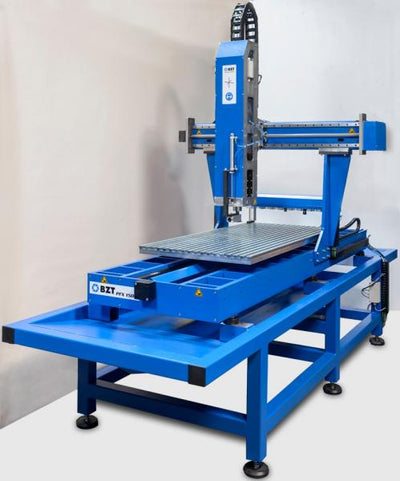
BZT Maschinenbau was founded in 2006 and produces a much broader range in Leopoldshöhe: 17 series from the compact entry-level PFI model to the large-format PFG-S machine with travel of more than eight metres. BZT is aimed at professional workshops: joinery shops, sign makers, professional model makers, metalworkers and industrial companies. The machines are built to configuration; individual components such as spindle, controller and guides can be adapted to the application. You will find an overview of all models on the series comparison page.
Put simply: Stepcraft is a system that grows with the user, within the hobby and semi-professional class. BZT is a machine that is configured to suit a specific application, from getting started through to series production.
One important difference lies in the sales model. Stepcraft sells mainly standardised finished products from its online shop, including accessory packages, software licences and tool sets. BZT sells configured machines: the model designation (for example PFE 1300) only describes the basic frame, and spindle, controller, tool changer, vacuum table and dust extraction are selected to suit the application. For buyers this means: Stepcraft is predictable and quickly available, while BZT offers more customisation but needs a short consultation phase.
Direct Model Comparison
The following table compares typical models from both manufacturers. Stepcraft is represented by the compact D.840 and the larger M.1000, BZT by the three series PFK (compact), PFE (professional entry-level) and PFU (universal machine). Prices given are list prices or guide values; BZT machines are priced according to configuration.
| Criterion | Stepcraft D.840 | Stepcraft M.1000 | BZT PFK | BZT PFE | BZT PFU |
|---|---|---|---|---|---|
| Price range | from approx. €2,499 | from approx. €3,449 | mid four-digit range | upper four-digit to lower five-digit range | five-digit range |
| Travel X | 600 mm | 1000 mm | 300–720 mm | 510–1510 mm | 1010–3020 mm |
| Travel Y | 420 mm | 790 mm | 300–420 mm | 510–1010 mm | 1010–2010 mm |
| Travel Z | 140 mm | 140 mm | 110–160 mm | 160–250 mm | 200–300 mm |
| Materials | Wood, plastic, foam, thin aluminium | Wood, plastic, limited aluminium | Wood, plastic, soft metal | Wood, plastic, aluminium, non-ferrous metals | Wood, plastic, aluminium, non-ferrous metals |
| Machine bed | Aluminium profile frame, T-slot table | Aluminium profile frame, MDF/T-slot table | Welded steel frame, T-slot aluminium plate | Welded steel frame, T-slot aluminium plate | Welded steel frame, T-slot aluminium plate |
| Drive | Stepper motor, toothed belt (X/Y), trapezoidal lead screw (Z) | Stepper motor, ball screw optional | Stepper motor with ball screws | Stepper motor with ball screws, servo optional | Servo or stepper motor, ball screw/rack |
| Spindle options | 43 mm mount, Stepcraft tools | 43 mm mount, HF spindle optional | HF spindle 0.8–2.2 kW | HF spindle 1.5–4 kW, tool changer optional | HF spindle 2.2–7.5 kW, ATC optional |
| Controller | UCCNC oder WinPC-NC | UCCNC, WinPC-NC, NCdrive | BZT control cabinet, WinPC-NC or Mach3/4 | BZT control cabinet, WinPC-NC, Mach3/4 or NCdrive | BZT industrial control cabinet, NCdrive or Beckhoff |
| Target group | Hobby, model making, education | Semi-pro, small workshop | Hobby, education, small workshop | Joinery, sign making, professional entry level | Workshop, series production, light industry |
| Installation site | Workbench, hobby room | Workbench, small studio | Workbench, basement workshop | Workshop floor, dedicated floor space | Workshop hall, industrial environment |
The table makes the fundamental difference visible: Stepcraft relies on aluminium profile frames and a compact design, BZT on welded steel frames with much greater travel. If you have a workshop with dedicated floor space and a three-phase connection, you are operating in a different league in terms of both price and mechanics.
Another point to note is clearance height, i.e. the usable height beneath the gantry. Stepcraft typically manages with 140 mm of Z travel, which is enough for flat workpieces. Depending on the series, BZT offers 110 to 500 mm of Z travel, and on the PFE an optional raised gantry, under which even workpieces with clamping devices or fixtures fit without difficulty. For users who machine aluminium profiles on the end face or mill three-dimensional models, this difference is decisive.
When Stepcraft Is the Right Choice
Stepcraft has clear strengths in the hobby and semi-professional sector. The machines are transportable, need little space and in many cases can simply be connected to a standard mains socket. Operation is designed for users who do not come from mechanical engineering: CAM templates, an extensive academy and an active forum significantly lower the barrier to entry.
Stepcraft is the right choice if you:
- mainly machine wood, plastic, foam or thin aluminium sheet,
- want a modular system with extensions such as a 3D printer, drag knife or plotter,
- work in a hobby room or a small workshop and have no hall space available,
- are looking for a clear complete package including software and tools,
- want to make use of a large community and many online tutorials.
The models up to and including the M.1000 cover the hobby and maker sector solidly. For model making, laser engraving, small signs and occasional aluminium work, Stepcraft is a well-designed system, and thanks to brand recognition the resale value is stable.
In this class, the argument of “learning with a system” is also important. Anyone who has never worked with a CNC machine benefits from a dense ecosystem of tutorials, templates and forums, and that is exactly what Stepcraft delivers. The learning curve of a BZT is not steeper, but it is less thoroughly documented; here the help relies more on personal advice. For educational institutions, vocational schools and maker spaces that have to get many users up to speed quickly, this is a real advantage in Stepcraft’s favour.
When BZT Is Superior
As soon as the requirements go beyond the hobby sector, the comparison tips. BZT is superior if you regularly machine larger workpieces, work productively with aluminium or need a machine that is in use for several hours every day. The welded steel frame, the ball screws or rack drives in the larger series and the HF spindles with up to 7.5 kW of power allow significantly higher feed rates, depths of cut and cutting forces.
BZT is the better choice if you:
- need travel of more than 1000 mm in the X direction (furniture making, sign making, aluminium sheets),
- see aluminium, brass or light steel machining as a regular application,
- want a configurable machine, with a choice of spindle, controller, tool changer and dust extraction,
- can plan for dedicated floor space, a three-phase connection and a suitable cyclone separator,
- expect long-term spare parts supply and individual modernisation.
The PFE series is the typical professional entry point, the PFU the universal machine for workshops with more space. For pure joiners with XXL requirements there is also the PFL series as a large-format solution.
An often underestimated advantage: BZT machines can still be modernised after many years. New controller, more powerful spindle, additional tool changer, optional rotary axis, vacuum table: all of this is also retrofitted to existing machines. With Stepcraft machines, such modifications are bound by the limits of the modular system. Anyone who wants to use the machine productively for 10 to 15 years gains with BZT a platform that does not need to be replaced but can grow.
Suitability for Aluminium Compared
Aluminium is the most important pain point in this class. Stepcraft machines can mill aluminium, but with limitations. The aluminium profile frame is lighter and less rigid than a welded steel frame, the toothed-belt drives in the D-Series limit the cutting forces, and the maximum spindle power is typically around 1 kW. In practice this means: aluminium plates under 5 mm thick, low depth of cut, low feed rates, preferably with minimum quantity lubrication (MQL). A suitable ventilation and chip management concept is mandatory.
From the PFE upwards, BZT machines are designed for productive aluminium machining. The welded steel frame with T-slot aluminium plate dampens vibrations, the linear guides with ball screws ensure low-backlash movement, and the HF spindles deliver up to 4 kW (PFE) or 7.5 kW (PFU/PFH) at high spindle speeds. In combination with an HF spindle from BZT and industrial-grade cooling lubrication, aluminium plates up to 30 mm thick can realistically be machined, and thicker workpieces on the PFU-S.
Anyone who wants to produce aluminium front panels, housings, profiles or brackets in series on a regular basis is much better served by a BZT machine. Anyone who only occasionally engraves or cuts an aluminium sheet will manage with a Stepcraft M.1000, but has to work more slowly and with more effort.
In concrete numbers: with 5 mm aluminium, a Stepcraft M.1000 typically achieves feed rates of 800–1500 mm/min with a depth of cut of 0.3–0.5 mm per pass. A BZT PFE with a 2.2 kW HF spindle operates in the same material at 2500–4000 mm/min and a 1–2 mm depth of cut. Over a whole shift this adds up to considerably shorter machining times, and therefore to a clear economic argument for professional users with a share of aluminium work.
Support, Service and Made in Germany
Both manufacturers are based in Germany and advertise with “Made in Germany”. Stepcraft develops in Iserlohn, produces individual components in-house and also outsources larger assemblies to partners. Support is provided via hotline, forum and the Stepcraft academy, and spare parts can be ordered directly in the online shop.
What the term “Made in Germany” really means for CNC milling machines (not a certified seal, what matters is the depth of manufacture) is explored in the guide CNC Milling Machine Made in Germany: What Lies Behind It?.
BZT has been developing and manufacturing in Leopoldshöhe since 2006. Steel construction, mechanical configuration and control cabinet building take place in its own hall. Support is personal: users usually speak directly to design engineers and service technicians. On request, machines are set up on site and users are trained, spare parts are available in the long term, and older machines can be modernised (new controller, new spindle, new axes).
The decisive difference in service: Stepcraft is designed for a broad customer base with standardised enquiries. BZT works more closely on the individual case, which is often more valuable in the professional sector, especially when a machine is to stay in operation for longer than planned. For questions about the right configuration, the advisory team helps with specific recommendations instead of standard answers.
There is also a practical difference when it comes to spare parts: Stepcraft components are available straight away in the online shop as consumable and wear parts (spindles, belts, tools). BZT keeps mechanical and control components partly backward-compatible for more than 15 years, which becomes important with discontinued spindles or motors. Users who make a machine the basis of their business benefit from this long life-cycle perspective.
Buying Recommendation by Application
In the end, the choice depends less on the manufacturer’s logo and more on the specific application. A Stepcraft is not a worse machine than a BZT; it solves a different task. Anyone looking for a machine for the workshop, for aluminium production or for larger workpieces will get more reserves, more accuracy and more longevity with a BZT. A complete overview of all models is in the CNC machine overview.
Frequently Asked Questions
Can I upgrade a Stepcraft to BZT level?
Only to a limited extent. Stepcraft machines are modular, but within their own system: you can swap spindles, change software and add tools. However, this does not change the aluminium profile frame, the drive type or the gantry rigidity. If you regularly need aluminium series parts, larger workpieces or higher feed rates, switching to a BZT machine makes more sense than stacking expensive upgrades.
Which machine is better for aluminium?
For occasional aluminium milling, a Stepcraft M.1000 with HF spindle, low depth of cut and low feed rates is sufficient. For productive aluminium machining, meaning series parts, thicker plates and longer run times, a BZT from the PFE series upwards is clearly superior. In the PFU-S with reinforced construction and a 4–7.5 kW HF spindle, aluminium workpieces can be manufactured economically in series.
Where are BZT and Stepcraft manufactured?
Stepcraft develops and manufactures in Iserlohn (North Rhine-Westphalia); individual assemblies come from partners. BZT Maschinenbau has been manufacturing in Leopoldshöhe since 2006: steel construction, axis configuration and control cabinet building take place in its own hall. Both manufacturers can therefore state “Made in Germany”, but BZT has a significantly greater depth of in-house manufacture.
Are BZT machines available as a kit?
Yes. BZT also offers selected series such as the PFE or PFK as a kit, for users who want to do the assembly themselves and thus save considerably. Unlike Stepcraft, however, the BZT kits are not intended for absolute beginners, but require experience in mechanical engineering or careful preparation. Details and current availability can be found on the series overview.
Which controller do the manufacturers use?
Stepcraft typically uses UCCNC or WinPC-NC, both established PC-based controllers with a manageable learning curve. BZT supplies its machines with a choice of WinPC-NC, Mach3/Mach4, NCdrive or an industrial Beckhoff controller, depending on the series and application. In the online shop you will find the complete range of CNC controllers. The choice of controller is part of the configuration and should suit the CAM workflow, IT environment and operator experience.
Advice Instead of Gut Feeling
A CNC gantry milling machine is an investment for many years. Anyone torn between Stepcraft and BZT should not only compare prices and data sheets, but describe their own application honestly: Which materials? Which workpiece sizes? Which quantities? How many hours per week? On this basis it can be decided clearly whether a modular hobby system is enough or whether a workshop machine is the economically better choice.
If you are unsure which BZT series suits your workshop, the advisory team will help with a specific recommendation, including a proposal for spindle, controller and accessories. You will find a compact overview of all models in the series comparison table.



0 comments