

When choosing a CNC milling machine, beginners and professionals alike stumble over the question: stepper motor or servo motor? Both drive the axes and both position precisely, but they work on different principles, with different strengths and in different price classes.
In this technical guide we explain how both drive types work, compare their properties and help you decide for your application.
Basics: how do the drives work?
Stepper Motor: Movement in Defined Steps
A stepper motor is an electric synchronous motor that moves in precisely defined angular steps. Typical stepper motors have 200 full steps per revolution, i.e. 1.8° per step. Microstepping drivers can increase this resolution to 400, 800, 1600 or more microsteps.
The principle:
- The controller sends a pulse to the driver
- The driver switches the motor windings
- The rotor moves by one step (or microstep)
- With 500 pulses, the motor makes 500 steps
Open-loop control: The classic stepper motor drive works without feedback. The controller relies on every command being carried out; no verification takes place.
Servo Motor: Intelligent Position Control
A servo motor is a three-phase motor with an encoder. The encoder continuously measures the actual position and reports it back to the controller. If the actual position deviates from the target position, the control corrects it immediately.
The principle:
- The controller specifies a target position
- The servo moves towards the target position
- The encoder measures the current position
- The control compares target and actual position
- If there is a deviation, it is corrected
Closed-loop control: The system knows at all times where the motor actually is. Deviations are detected and corrected, or an error message is issued.
Closed-Loop Stepper Motors: The Best of Both Worlds
A more recent development is stepper motors with encoder feedback. They combine the simple control and the low price of stepper motors with the reliability of position monitoring.
In the event of lost steps (due to overload), the system detects the deviation and can react, either by correcting it or by issuing an error message.
Detailed Comparison of Properties
| Property | Stepper motor (open loop) | Stepper motor (closed loop) | Servo motor |
|---|---|---|---|
| Position feedback | None | Yes (encoder) | Yes (high resolution) |
| Lost steps possible? | Yes, unnoticed | Detected | Corrected |
| Torque at low motor speed | Very high | Very high | High |
| Torque at high motor speed | Drops significantly | Drops significantly | Remains almost constant |
| Maximum speed | Limited (approx. 1000 rpm) | Limited (approx. 1000 rpm) | Higher (approx. 3000+ rpm) |
| Holding torque at standstill | High (current required) | High (current required) | Through control |
| Heat generation at standstill | Motor gets warm | Motor gets warm | Low |
| Noise generation | Humming possible | Humming possible | Quieter |
| Control complexity | Simple | Medium | Complex (tuning required) |
| Acquisition cost | Low | Medium | High |
Torque Behaviour in Detail
A decisive difference lies in the torque-speed behaviour:
Stepper Motor
- Very high torque at low speeds (ideal for milling)
- Torque drops sharply as speed increases
- From approx. 600–1000 rpm, the force drops noticeably
- Not ideal for fast rapid traverse
Servo Motor
- Relatively constant torque over a wide speed range
- Full force even at high speeds
- Ideal for fast positioning movements
- Better dynamics when changing direction
Practical example: With a typical rapid traverse of 15 m/min on a gantry milling machine, the drive runs at 500–1000 rpm, depending on the gear ratio. A stepper motor still performs well here. At rapid traverse speeds of 30+ m/min (typical for industrial machines), the servo motor has clear advantages.
When are stepper motors enough?
For most CNC milling applications, modern stepper motors are the most economically sensible choice:
Ideal Applications for Stepper Motors
- Woodworking and plastics machining: Moderate cutting forces, no extreme speeds
- Engraving and lettering: High precision, but low forces
- Aluminium with adjusted parameters: Moderate feed rates, several passes
- Sign making: Long travel, but moderate dynamics
- Model making and prototypes: Versatility more important than maximum speed
- Small series and one-offs: Cost-effectiveness takes priority
Recommendation: Closed-Loop Stepper Motors
For additional reliability we recommend closed-loop stepper motors:
- Only a small extra cost compared with open loop
- Detection of lost steps under overload
- Particularly valuable for unattended operation
- Avoids expensive rejects caused by unnoticed position errors
When are servo motors worthwhile?
Servo motors show their strengths in more demanding scenarios:
Ideal Applications for Servo Motors
- Industrial series production: Highest productivity through fast rapid traverse
- Heavy machining: High cutting forces with steel or hardened materials
- Continuous operation in multi-shift systems: Constant performance without overheating
- Very high dynamics: Fast changes of direction, high-frequency movements
- Precision in the micrometre range: High-resolution encoders enable the finest positioning
Cost Considerations
A servo motor system (motor + driver + encoder) costs roughly 2–4× as much as a comparable stepper motor. On a 3-axis machine, the additional cost can easily amount to €2,000–5,000. The application has to justify this extra cost through higher productivity or quality.
Sizing: how much torque do I need?
Regardless of the motor type, the drive must be adequately sized.
Rules of Thumb for Sizing
- X and Y axes: They must accelerate the gantry plus tool. On larger machines, correspondingly stronger.
- Z axis: It must hold the spindle and work against gravity. Brake recommended.
- Allow a reserve: 30–50% reserve torque for acceleration and safety
Typical Motor Sizes for CNC Milling Machines
| Machine size | Stepper motor (Nm) | Servo motor (Nm) |
|---|---|---|
| Small (up to 600 x 400 mm) | 1.5–3 Nm | 1–2 Nm |
| Medium (up to 1200 x 800 mm) | 3–6 Nm | 2–4 Nm |
| Large (up to 2000 x 1500 mm) | 6–12 Nm | 4–8 Nm |
| Industrial (larger) | 10–20 Nm | 6–15 Nm |
Note: Servo motors achieve similar forces with smaller frame sizes because they do not have the holding torque problem of stepper motors.
BZT Drive Options
At BZT you can choose, depending on your requirements:
Standard Equipment: High-Quality Stepper Motors
- Proven industrial quality
- Optimally sized for the respective machine size
- The best choice for most applications
Option: Closed-Loop Stepper Motors
- Encoder monitoring for increased safety
- Recommended for unattended operation
- Moderate extra cost
On Request: Servo Motors
- For industrial requirements
- Higher dynamics and rapid traverse
- Individual adjustment required
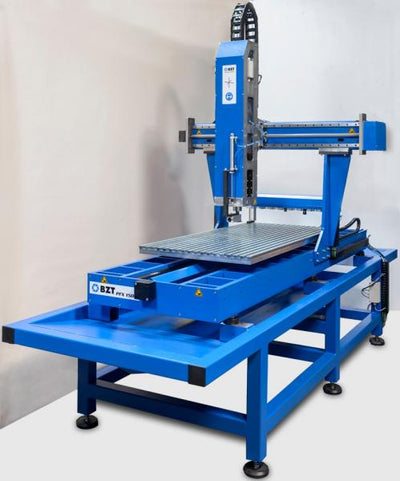
Our heavy machines such as the PFH series and PFX series are designed to work optimally with both drive types.
FAQ: Frequently Asked Questions About Stepper Motors vs. Servo Motors
Can I convert my stepper motors to servos later?
In principle yes, but the effort is considerable: new motors, drivers and possibly adjustments to the controller. It is better to plan the right drive configuration from the start.
Why do stepper motors hum at standstill?
Stepper motors hold their position through constant current. This produces micro-vibrations that are audible as humming. High-quality drivers with intelligent current reduction minimise this problem.
What happens if steps are lost?
With open-loop stepper motors: the machine keeps milling with an offset, and the part is scrap. With closed-loop systems or servos: the system detects the error and stops or corrects.
Are servo motors more precise than stepper motors?
Not necessarily. Both achieve positioning accuracy in the hundredths range when set up correctly. The difference lies more in the dynamics and the positional reliability under load.
Which drive type is quieter?
Servo motors tend to be quieter, especially at standstill and during slow movements. During fast machining, however, the cutting noise is usually the loudest, and the motor is then of secondary importance.
Conclusion: The Right Choice for Your Application
For the typical BZT user (model makers, prototype builders, sign makers, joinery workshops), modern stepper motors are the best choice: they are inexpensive, reliable and entirely sufficient for most materials and speeds.
Our recommendation by application:
- Hobby/beginners: Open-loop stepper motors, simple and inexpensive
- Commercial/continuous operation: Closed-loop stepper motors, safety through monitoring
- Industry/heavy machining: Servo motors, maximum performance and dynamics
If in doubt, we will be happy to advise you on the optimal drive configuration for your specific application.
Questions about drive technology? Contact our technical team and we will help you make the right decision.



0 comments