

You have made up your mind: you want a CNC milling machine. But between a cheap import for €500 and an industrial system for €50,000 lies a world of difference. Where is the sweet spot? And what really matters? This comprehensive buying guide gives you all the decision criteria you need.
Quick Navigation: In-Depth Guides
Before You Buy: The Most Important Questions
Before you go into the technical details, clarify these basic questions:
What do you want to machine?
The material determines the machine requirements more than anything else:
- Wood and plastic only: medium rigidity is enough, many machines are suitable
- Aluminium as well: much higher demands on rigidity and spindle power
- Brass, bronze, steel: industrial-grade machines only
→ Detailed material comparison in the material guide
What part sizes do you need?
The travel range determines how large your workpieces can be. Note that travel range is not the same as clamping surface: you need room for the workholding.
How often will you use the machine?
Occasional hobby use makes different demands from daily production. Continuous running calls for more robust components.
The Truth About Accuracy
Every manufacturer advertises accuracy figures such as “0.01 mm repeatability”. But what does that mean in practice?
The uncomfortable truth: positioning accuracy is only one part of the equation. What really counts is the machining accuracy under load, that is, how precisely your machine works when the cutter is actually removing material.
A soft machine yields under load, and your workpiece ends up larger or less accurate than planned. Rigidity is decisive, and it comes from the design.
The 5 Pillars of a Good CNC Milling Machine
1. Machine Frame: The Foundation
The frame determines the basic rigidity of your machine. This is where the wheat is separated from the chaff:
Aluminium profiles:
- Inexpensive and light
- Only about 1/3 of the rigidity of steel with the same cross-section
- Acceptable for light work in wood
- Critical for metalworking
Steel construction:
- Much stiffer and better at damping vibration
- Higher weight = more stability
- Ideal for demanding materials
- Long-term stable
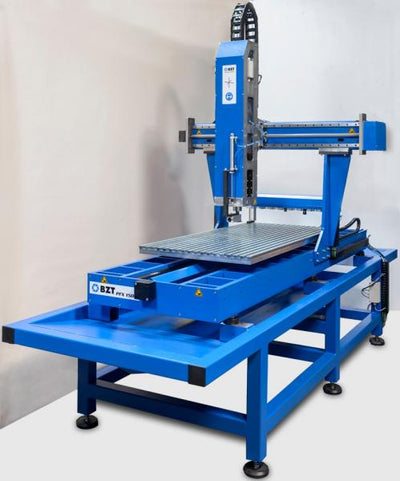
The BZT philosophy: our machines in the higher classes are based on welded steel frames. These are stress-relieved by annealing (internal stresses are removed) and then CNC-milled. The result: a base that keeps its shape for years.
Practical tip: tap the gantry of the machine you have in mind. A dull “thunk” points to mass and stability. A hollow “ping” is a warning sign.
2. Linear Guides: The Underrated Component
The guides of the X, Y and Z axes must be free of play and absorb forces. There are massive differences in quality:
| Guide type | Advantages | Disadvantages | Suitable for |
|---|---|---|---|
| Round rods + linear bearings | Inexpensive | Critical under side loads | Light engraving |
| Basic profile rails | Better than round rods | Quality varies widely | Wood, light plastics |
| Branded profile rails (15–20 mm) | Industrial quality | Higher price | Aluminium, precision work |
| Large profile rails (25 mm+) | Maximum load capacity | Highest price class | Heavy machining, steel |
On the PFE series and above, BZT uses linear guides from Bosch Rexroth, an industry standard with proven quality.
3. Drive: How the Axes Are Moved
The drive converts the rotation of the motor into linear motion. There are two main systems:
| Criterion | Ball screw | Toothed belt |
|---|---|---|
| Accuracy | Very high (free of play) | Good (depends on tension) |
| Feed force | High | Moderate |
| Speed | Solid (depending on pitch) | Very high possible |
| Maintenance | Lubricate regularly | Check tension |
| Cost | Higher | Lower |
Recommendation: for metalworking and precision work, choose a ball screw. For very long axes (over 2–3 metres) we use driven nuts: here the nut rotates, not the screw. The advantage: no “whip” (oscillation) of the long screw.
→ In depth: stepper motor vs. servo motor in a drive comparison
4. Spindle: The Heart of the Machine
The spindle turns your cutter. There are two main options:
Router motors (e.g. AMB, Mafell):
- Inexpensive (€300–600)
- Easy to replace if faulty
- Solid for getting started
- Louder in operation
- Shorter service life in continuous use
HF spindles (high-frequency):
- Higher investment (€800–3,000+)
- Very quiet, especially when water-cooled
- Excellent run-out
- Long service life
- True speed control via frequency inverter
Our gantry mills are prepared for both options. The mount (43 mm Euro standard) is compatible, so you can start with a router motor and upgrade to an HF spindle later.
→ Detailed comparison: HF spindle vs. router motor
5. Controller and Software
The controller is the brain of your machine. Important aspects:
- Compatibility: which software is supported?
- Interfaces: USB, Ethernet, parallel port?
- Expandability: tool length measurement, 4th/5th axis possible?
- Support: is there documentation and help in German?
→ Software guide: CAD/CAM for beginners
Kit vs. Ready-Built Machine
A common question: build it yourself or buy it ready-made?
Advantages of a Kit
- Lower entry price
- You understand the machine better
- Repairs are easier
Disadvantages of a Kit
- Time required (often 40–80 hours)
- Precision depends on your skills
- No guarantee on the complete system
- Troubleshooting is harder
Advantages of a Ready-Built Machine
- Ready for use immediately
- Support for the complete system
- Time for projects instead of machine building
Our recommendation: if you want to use the machine productively, a ready-built machine is worth it. You can spend the time you save on projects, and you have a contact person if problems arise.
The Checklist Before You Buy
Clarify Before Buying
- What is my main material? (wood/plastic vs. aluminium vs. steel)
- What maximum workpiece size do I need?
- Do I need 3D machining or only 2.5D contours?
- How much space do I have? (machine + dust extraction + access)
- What budget is realistic? (including accessories)
- Do I need a 4th/5th axis now or later?
Check With the Manufacturer
- Can I see or test the machine live?
- Are there test cuts in my material?
- What guarantee is there? What does it cover?
- Support in German? By telephone or only by email?
- Are spare parts available in the long term?
- Are there training courses or instruction sessions?
Watch Out for Hidden Costs
The machine price is not everything. Factor in these additional costs:
| Item | Typical costs | Remark |
|---|---|---|
| Dust extraction | €300–2,000 | Mandatory for wood/MDF |
| Basic cutter set | €150–400 | Solid carbide cutters in various sizes |
| Workholding | €100–500 | T-slot set, hold-down clamps |
| Software (CAM) | €0–2,000 | From free to professional |
| Vacuum table (optional) | €500–2,000 | Very useful for sheet machining |
| 4th/5th axis (optional) | €1,000–5,000 | For round parts and complex 3D work |
In-Depth Accessory Guides
BZT Gantry Mills at a Glance
We offer machines for different requirements. Made in Germany:
| Series | Construction | Special feature | Typical application |
|---|---|---|---|
| PFK | Compact | Space-saving, entry level | Hobby, small parts |
| PFE | Steel frame, Bosch Rexroth | Ball screws, 5-axis capable | Prototypes, mould making, engraving |
| PFU-S | Reinforced steel frame | 25 mm guides, gantry drive | Aluminium, hard plastics |
| PFH | Solid steel construction | Up to 15 kW spindle, ATC possible | Industry, steel, continuous operation |
Typical Mistakes When Buying a CNC Machine
Mistake 1: Looking Only at the Price
A cheap machine that does not deliver the quality you want is no saving. You invest time in rework and frustration instead of productive work.
Mistake 2: Underestimating Accessories
The machine alone does not make parts. Dust extraction, workholding, cutters and software are essential: plan at least 20–30% of the machine price for accessories.
Mistake 3: Buying Too Small
The machine always turns out too small. If you cannot decide between two sizes, choose the larger one. You will not regret it.
Mistake 4: Ignoring Support
At some point you will have a problem. A manufacturer with good German-language support is worth its weight in gold. Ask about support options before you buy.
→ More on this: 5 common CNC mistakes and how to avoid them
FAQ: Frequently Asked Questions About Buying a CNC Machine
Can I mill aluminium with an inexpensive machine?
Technically yes, but in practice often frustrating. Inexpensive machines have too little rigidity: you have to run extremely slowly and still get mediocre results. For regular aluminium machining, a more stable machine is worthwhile.
→ Milling aluminium: the complete guide
Do I need a frequency inverter for an HF spindle?
Yes, HF spindles need a frequency inverter (FI) to control the speed. Allow for an additional €200–500. The FI must match the spindle, so ask about it when you buy.
Is a vacuum table worth it?
For sheet machining and series production: definitely yes. Clamping is much faster, and you have no workholding in the way. For 3D parts and one-offs, T-slots are often enough.
→ Vacuum table guide: when is it worth it?
Conclusion: Investing in Quality Pays Off
A CNC milling machine is a long-term investment. Do not save on the foundation: a wobbly frame makes even an expensive spindle useless. Look for:
- Solid construction suited to your materials
- Quality guides from established manufacturers
- Expandability for future requirements
- Good support in your language
Keep Reading in the Knowledge Centre
Do you have questions about your specific application? Our team will be happy to advise you, from choosing the machine to the final configuration.
Discover BZT CNC Milling Machines
Find the right CNC gantry mill for your requirements:
- All CNC gantry milling machines: 17 series, over 100 variants
- BZT PF Series: the affordable entry to the CNC world
- BZT PFE Series: our bestseller for trades and small businesses
- CNC controllers: matching controllers for every machine
- Series comparison: all series at a glance



0 comments