

Wood, plastic, aluminium or steel? The choice of material determines the tools, the parameters and ultimately the success of your CNC project. This overview shows you which materials you can machine with a CNC milling machine and what to watch for with each.
Material Overview at a Glance
| Material | Difficulty | Typical application | Special feature |
|---|---|---|---|
| Wood | Easy | Furniture, model making, signs | Observe grain direction |
| Plastic | Medium | Prototypes, housings, sign making | Heat build-up is critical |
| Aluminium | Demanding | Mechanical engineering, precision parts | Lubrication recommended |
| Steel | Very demanding | Toolmaking, heavy-duty applications | Often better: plasma |
Wood: The Beginner-Friendly Classic
Wood is an ideal material for CNC beginners. It forgives small mistakes, can be machined with simple tools and quickly delivers presentable results.
Wood Types Compared
| Wood type | Hardness | Machinability | Typical use |
|---|---|---|---|
| Plywood (poplar) | Soft | Very good | Model making, prototypes |
| Plywood (birch) | Medium | Good | Furniture, structural parts |
| MDF | Homogeneous | Very good | Painted parts, moulds |
| Beech/oak | Hard | Medium | Fine furniture |
| Balsa | Very soft | Caution | Model aircraft building |
Important with wood: Always work with the grain, never against it. Use sharp tools and dust extraction: wood dust is not only a nuisance but also harmful to health.
Plastic: Versatile but Temperature-Sensitive
Plastics offer enormous variety, from crystal-clear acrylic to engineering plastics such as POM. The biggest challenge is heat build-up. If the plastic gets too hot, it melts onto the cutter.
The Most Important Plastics
| Plastic | Properties | Challenge | Application |
|---|---|---|---|
| PMMA (acrylic) | Transparent, glossy | Prone to cracking | Illuminated letters, displays |
| POM | Hard, low-friction | Melts easily | Gears, plain bearings |
| PA (nylon) | Tough, wear-resistant | Absorbs moisture | Mechanical parts |
| PE/PP | Soft, chemical-resistant | Poor surface finish | Containers, cutting boards |
| Rigid PVC foam | Light, low-cost | Not UV-stable | Signs, trade fair displays |
Golden rule: Better too fast than too slow. High feed rates prevent the cutter from rubbing in one spot for too long and heating the material.
→ Complete Plastic Milling Guide
Aluminium: The Royal Road to Precision
Aluminium combines good machinability with excellent mechanical properties. It is the step from hobby to semi-professional production, but it also requires more care.
Success Factors for Aluminium
- Alloy selection: AlMgSi1 (6082) and AlCuMgPb (2007) machine best
- Lubrication: Minimum quantity lubrication (MQL) extends tool life considerably
- Climb milling: Always work with climb milling for better surfaces
- Chip removal: Single-flute cutters with polished flutes
Typical beginner mistake: Milling too slowly. Aluminium wants to be cut fast, otherwise the cutter just rubs and the material sticks.
→ Complete Aluminium Milling Guide
Steel and Cemented Carbides: Limits of the Gantry Mill
Milling steel is possible, but it is not the strength of gantry mills. Cutting forces are high, speeds are low and tool wear is enormous.
Alternatives for Steel
- Plasma cutting: Ideal for contours and blanks up to 50 mm
- Waterjet cutting: Cold and precise, but expensive
- External manufacturing: Often more economical than machining steel in-house
If you regularly need to cut thick steel plate, a CNC plasma system is the better choice.
Composite Materials: GRP and CFRP
Glass fibre (GRP) and carbon fibre (CFRP/carbon) are popular in model making and lightweight construction. Machining them requires particular care:
- Health protection: Fibre dust is harmful to health, so an FFP3 mask and dust extraction are mandatory
- Diamond-coated tools: Normal solid carbide cutters wear extremely quickly
- Avoiding delamination: Compression cutters or working from both sides
Tool Recommendations by Material
| Material | Cutter type | Flutes | Coating |
|---|---|---|---|
| Soft wood | Single-flute cutter | 1 | Uncoated |
| Hard wood / MDF | Two-flute cutter | 2 | Optional TiN |
| Plastic | Polished single-flute cutter | 1 | Uncoated |
| Aluminium | Single-flute cutter for aluminium | 1 | DLC or polished |
| GRP/CFRP | Diamond cutter | 2 | Diamond |
Which BZT machine for which material?
| Focus | Recommended series | Rationale |
|---|---|---|
| Wood, plastic | PF, PFK, PFE | Sufficient for soft materials |
| Aluminium, regular use | PFE, PFU-S | Higher rigidity required |
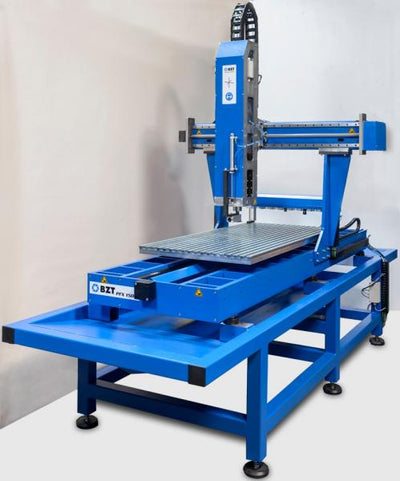
| Aluminium, intensive use | PFH, PFX | Maximum stability |
| Steel (cutting to size) | PFU-G Plasma | Thermal cutting is more efficient |
FAQ: Frequently Asked Questions About Material Choice
Can I also mill aluminium with a wood CNC machine?
In principle yes, but with limitations. For occasional aluminium work, lighter machines are sufficient. For regular aluminium machining, you should make sure the machine is sufficiently rigid, such as the PFE series or higher.
Which material is suitable for prototypes?
For quick prototypes we recommend POM or MDF. Both are low-cost, easy to machine and deliver clean results. For functional prototypes under mechanical load, aluminium is the better choice.
Why does my plastic melt during milling?
The feed rate is too slow or the tools are blunt. The cutter rubs instead of cutting, generates heat, and the plastic melts. Solution: increase the feed rate, use sharp single-flute cutters and, if necessary, cool with compressed air.
Do I need different cutters for every material?
In principle yes. A universal cutter is a compromise: it can do everything, but nothing really well. For the best results, use material-specific tools. Minimum equipment: one set each for wood, plastic and, if applicable, aluminium.
Conclusion: The Right Material Makes the Difference
Material choice affects every aspect of your CNC project: tools, parameters, machine utilisation and ultimately the quality of the result. Start with wood to learn the basics. Move on to plastic once you have mastered the technique. And take on aluminium when you are ready for the next stage.
Not sure which material suits your project? Our technical team will be happy to advise you, from choosing the material to recommending the right machine.




0 comments