

Model making is in BZT’s DNA. Our company history began with the wish to build better machines for demanding model makers. Today we cover the full spectrum: from the ambitious RC pilot who mills his own formers to the design studio that produces design studies at 1:1 scale from Ureol.
Areas of Application
1. Model Aircraft (RC)
Every gram counts here. Balsa ribs and plywood formers must be milled with extreme precision so that the kit fits snugly later.
- Material: balsa, aircraft plywood, GRP/CFRP, Depron.
- Technique: use of very small cutters (down to 0.5 mm) for fine corners and nesting software for optimum material utilisation.
2. Architectural Models
Presentation models for competitions demand clean edges and absolute dimensional accuracy.
- Material: acrylic, polystyrene, wood, Finnish board.
- Special feature: facade elements are often engraved, or window openings are milled in series.
3. Technical Model Making / Mould Making
Production of master patterns (positives) for later casting in GRP/CFRP or silicone.
- Material: Ureol (model-making block material), aluminium, MDF.
- Requirement: 3D freeform surface machining (finishing) for perfect surfaces without rework.
The Right Machines for Model Makers
Getting Started: BZT PFE Series
Our PFE series is the model makers’ favourite.
- Precision: genuine ball screws and linear guides (Bosch Rexroth) make sure that a circle really is round, unlike simple belt drives.
- Rigidity: the steel construction even allows the occasional “outlier” into harder materials such as aluminium, for example for an undercarriage part.
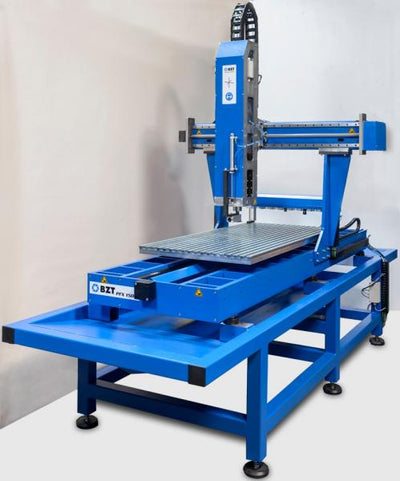
The Professional League: BZT PFX & PFG
For commercial model makers who need to machine large volumes (e.g. 1:1 design models in the automotive industry).
- Dynamics: high rapid traverse speeds shorten the run times of large 3D finishing programs considerably.
- Volume: large Z axes (up to 600 mm and more) allow tall block materials to be machined.
5-Axis Machining in Model Making
The call for five axes is getting louder, to mill undercuts or to avoid re-clamping.
- Solution: our machines can be equipped with rotary axes (4th axis) or 2-axis swivel heads (5-axis simultaneous). This lets you mill turbine wheels, hulls or complex figures in a single clamping.
Conclusion
Whether hobby or high-end industry: model making demands flexibility. With a BZT gantry milling machine you have a tool that grows with your ideas, from 2D panel machining to complex 3D shapes.




0 comments