

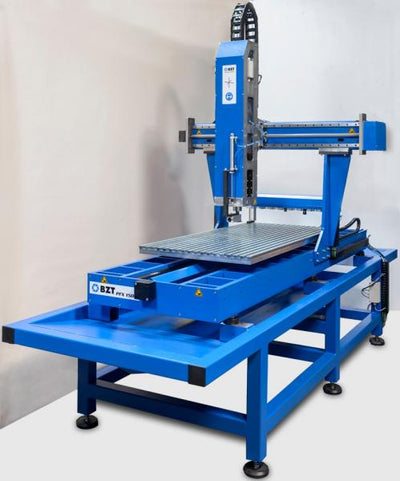
A CNC gantry milling machine is a versatile tool. But what exactly can you make with it? This overview shows the most important fields of application, from sign making through model making to industrial series production.
Applications at a Glance
| Industry | Typical parts | Materials | Special feature |
|---|---|---|---|
| Sign making | Signs, letters, displays | Acrylic, Dibond, PVC | Large travel ranges |
| Model making | Ribs, formers, fuselages | Plywood, balsa | High precision |
| Furniture making | Carcass parts, fronts | MDF, multiplex plywood | Nesting for efficiency |
| Prototyping | Housings, functional prototypes | Plastic, aluminium | Fast iteration |
| Engraving | Signs, jewellery, decoration | Wood, metal, acrylic | Fine detail |
Sign Making: Large Areas, Precise Details
Sign making is one of the main applications for CNC milling machines. From the simple house number to the illuminated company sign: everything is possible.
Typical Sign-Making Projects
- Exterior signs: Weatherproof signage made of Dibond or aluminium
- Illuminated letters: 3D letters with LED lighting
- Trade fair displays: Modular structures made of rigid PVC foam
- Shop window decoration: Seasonal decorations and brand staging
- Wayfinding systems: Uniform signage for building complexes
Machine recommendation: Travel ranges from 1250 x 2000 mm for standard half sheets. Vacuum table for quick sheet changes.
Model Making: Precision on a Small Scale
Model making was one of the first areas where CNC milling machines found their way into the hobby sector. The combination of precision and repeatability is ideal for demanding model makers.
Typical Model-Making Projects
- Model aircraft: Ribs, formers, milled-and-glued fuselages
- Ship models: Frames, decks, filigree fittings
- RC cars: Chassis plates made of carbon or GRP
- Architectural models: Façade elements, terrain models
- Model railways: Building models, landscape elements
Machine recommendation: Even compact machines (PFK series) are enough for most model-making projects. Precision matters more than size.
Engraving: From Lettering to Work of Art
CNC engravings range from simple lettering to elaborate reliefs. With the right tool and a little practice, impressive results are achieved.
Engraving Techniques
- Line engraving: Simple lettering and logos with a V-groove cutter
- Flat engraving: Recessed areas with an end mill
- 3D relief: Sculptural representations with a ball nose end mill
- Deep engraving: Stepped levels for depth effect
Machine recommendation: Good spindle run-out is decisive for clean engravings. HF spindles deliver better results than simple router motors.
Nesting and Series Production: Maximising Efficiency
For larger quantities, nesting becomes the decisive factor. Many parts are arranged efficiently on one sheet: minimal waste, maximum efficiency.
Nesting Applications
- Furniture making: Carcass parts, shelves, drawer parts
- Packaging: Foam inserts, shaped parts
- Shopfitting: Shelving, display furniture
- Interior fit-out: Wall cladding, acoustic panels
Machine recommendation: Large travel ranges (at least half a sheet) and a vacuum table are practically essential for efficient nesting.
More Fields of Application
Prototyping
Fast iteration is the key to successful product design. With a CNC milling machine, you produce functional prototypes within hours rather than weeks. Materials such as POM or aluminium enable durable prototypes for real tests.
Jewellery and Crafts
Filigree pendants, engraved rings, individual gifts: the CNC milling machine makes jewellery possible that can hardly be made by hand. Popular materials: brass, silver, wood, acrylic.
Musical Instrument Making
Guitar bodies, drum shells, keyboard housings: instrument making benefits from the precision of CNC. Particularly popular: individualised electric guitars with complex body shapes.
Mould Making
Moulds for vacuum forming, casting moulds, lamination moulds: with a CNC milling machine you produce master models and moulds for small-series production. Typical materials: MDF, Ureol, aluminium.
The Right Machine for Your Application
| Application | Recommended series | Min. travel range | Special equipment |
|---|---|---|---|
| Sign making | PFA, PFU-S | 1250 x 2000 mm | Vacuum table, dust extraction |
| Model making | PFK, PF, PFE | 400 x 600 mm | Precision spindle |
| Engraving | PFE, PFK | 300 x 400 mm | HF spindle |
| Nesting/furniture | PFU-S, PFG-S | 2500 x 1250 mm | Vacuum table essential |
| Prototypes | PFE, PFU-S | 600 x 400 mm | Versatility |
FAQ: Frequently Asked Questions About CNC Applications
What can I do as a beginner with a CNC milling machine?
Start with simple 2D projects in wood: signs, decorative items, simple pieces of furniture. As you gain experience, you can venture into more complex projects and more demanding materials.
Is a CNC milling machine worth it for my hobby?
If you regularly need precise parts (whether in model making, for DIY furniture or creative projects), the investment pays off quickly. The time saved and the gain in quality compared with manual work are enormous.
Can I cover different applications with one machine?
Yes, that is one of the great advantages of CNC gantry milling machines. The same machine can mill wood today, machine aluminium tomorrow and engrave acrylic the day after. Only the tools and parameters need to be adjusted.
Which application is the most demanding?
Aluminium machining and nesting in continuous operation require the most stable machines. For wood, plastic and occasional engraving, lighter series are also sufficient.
Conclusion: Unlimited Possibilities
A CNC gantry milling machine is not a specialised machine for a single task, it is a universal tool for countless applications. Whether you produce signs for customers, build model aircraft or develop prototypes: the right machine with the right equipment opens all doors for you.
Not sure whether your planned application is feasible? Contact our technical team, we are happy to advise you using specific project examples.




0 comments