

Minimum quantity lubrication (MQL), known in German as MMKS, is a clever alternative to classic wet machining with cutting fluid. Instead of flooding the workpiece, a fine oil mist is sprayed directly at the cutting edge. This saves costs, protects the environment and can even deliver better results.
What is MQL and how does it work?
In minimum quantity lubrication, tiny amounts of lubricating oil (typically 5–50 ml per hour) are mixed with compressed air and sprayed as a fine mist at the point of cut.
The Principle
- Oil: Lubricates and reduces friction
- Compressed air: Carries the oil and cools through expansion
- Dosing: Only as much as necessary, directly at the cutting edge
Comparison With Wet Machining
| Criterion | Wet machining | MQL |
|---|---|---|
| Amount of cutting fluid | Litres per minute | Millilitres per hour |
| Workpiece after machining | Wet, must be cleaned | Almost dry |
| Chips | Wet, complex disposal | Dry, easy to recycle |
| Maintenance | Check concentration, maintenance required | Minimal |
| Health | Cutting fluid mist, skin irritation possible | Less exposure |
| Costs | Cutting fluid consumption, disposal, cleaning | Only a little oil |
Advantages of Minimum Quantity Lubrication
Economic Advantages
- Lower operating costs: Up to 90% less lubricant consumption
- No cutting fluid disposal: Dry chips are easy to dispose of
- Less cleaning: Workpieces are almost dry
- Simpler chip disposal: Higher payment for dry metal chips
Technical Advantages
- No thermal shock: More even temperatures at the cutting edge
- Often longer tool life: Less thermal cycling stress
- Better visibility: No cutting fluid mist obstructing the view
- Clean machine: Fewer deposits and less dirt
Environment and Health
- Fewer chemicals: Minimal oil consumption instead of litres of cutting fluid
- No cutting fluid mist: Better for the airways
- Less skin contact: No handling of wet workpieces
- Simpler disposal: No hazardous waste issues
When does MQL make sense?
Ideal Applications
- Aluminium machining: Highly suitable, prevents built-up edge formation
- Dry chips required: When chips are to be recycled
- Clean parts required: Medical technology, electronics
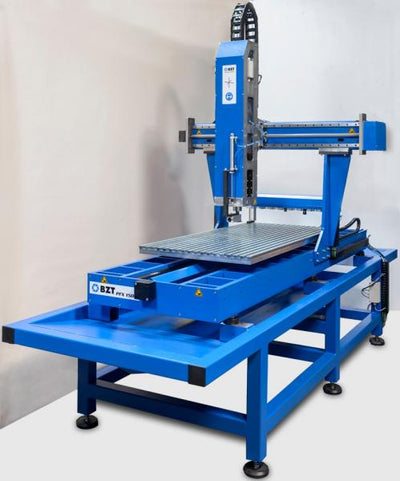
- Gantry mills without cooling: MQL is easy to retrofit
Less Suitable
- Very high machining heat: For extreme steel machining, the cooling is not sufficient
- Deep holes: The oil does not reach the target
- Highest surface quality: Wet machining is sometimes superior
MQL Systems: Design and Components
Basic Components
- Oil reservoir: Holds the lubricating oil
- Dosing system: Controls the amount of oil (manual or automatic)
- Mixing chamber: Oil and air are mixed
- Nozzle: Sprays the mist at the cutting edge
- Compressed air supply: Typically 4–6 bar
Single-Channel vs. Dual-Channel
| System | Function | Advantages | Disadvantages |
|---|---|---|---|
| Single-channel | Oil-air mixture in one hose | Simple, low-cost | Mixture can separate |
| Dual-channel | Oil and air separate up to the nozzle | More precise dosing, more stable | More complex, more expensive |
External vs. Internal Supply
- External: The nozzle sprays onto the cutting edge from the outside, easy to retrofit
- Internal: Through the spindle and tool, very effective but more complex
For gantry mills, external supply is usually sufficient and easy to implement.
Choosing the Right Oil
Not every oil is suitable for MQL. Important properties:
- Low viscosity: Must be easy to spray finely
- High flash point: Safety when heat is generated
- Good lubricating effect: Minimise friction
- Harmless to health: The oil mist is inhaled
- Low evaporation: Few residues
Tip: Use oils formulated specifically for MQL. Normal machine oils are often unsuitable.
Setup and Adjustment
Setting the Oil Quantity
Start with a medium setting and adjust:
- Too little oil: Dry running, increased wear, built-up edge on aluminium
- Too much oil: Oil film on the workpiece, smeared appearance, wasted oil
- Just right: Slightly damp chips, no dry-running noise, clean workpiece
Nozzle Position
- Nozzle as close to the cutting edge as possible
- The spray mist should hit the cutting zone directly
- Adjust the angle: not against the airflow of the dust extraction
Air Pressure
- Typically 4–6 bar
- Higher means finer mist, but stronger cooling
- Lower means coarser mist, less turbulence
MQL With Different Materials
Aluminium
Highly suitable. MQL prevents built-up edge formation better than some cutting fluid emulsions. Dry aluminium chips fetch better prices when recycled.
Steel
Possible for light to medium machining. For heavy machining, the cooling is often not sufficient.
Plastic
Often not necessary at all. If used at all, then only to prevent melting in heat-sensitive plastics.
Wood
Not recommended. Oil discolours the wood and interferes with the surface coating.
Retrofitting to Existing Machines
MQL can often be retrofitted easily:
- MQL unit: Compact units from about €200
- Compressed air: A workshop compressor is usually sufficient
- Nozzle holder: Mount on the spindle or Z axis
- Hoses: Route flexible lines
Effort: for experienced users, an afternoon project.
FAQ: Frequently Asked Questions
Does MQL replace dust extraction?
No. Dust extraction remains important for chips and dust. MQL only replaces liquid cooling.
Can I use normal machine oil?
Not recommended. Normal machine oils often have the wrong flash point or are not formulated for spraying. Use special MQL oil.
How much can be saved compared with cutting fluid?
Highly dependent on the application. Small workshops often see 50–80% lower lubricant costs, plus savings on disposal and cleaning.
Does MQL smell?
High-quality MQL oils have a low odour. Even so, the working area should be ventilated, as with any oil-based machining.
Conclusion: MQL Is a Clever Solution
Minimum quantity lubrication is not a stopgap but a well-thought-out alternative to classic wet machining. Especially with aluminium, and when dry chips are desirable, MQL is often the better choice.
For gantry mill users: MQL is a simple way to improve machining quality on aluminium without complex cooling systems.
Related Accessories Guides
Would you like to retrofit MQL to your machine? We will be happy to advise you on suitable solutions.




0 comments