

A CNC milling machine produces noise, dust and chips, especially when machining wood, plastic or aluminium. A well-thought-out enclosure solves several problems at once: it reduces the noise level, keeps the workshop clean and increases safety. Here you will learn what matters.
Why an Enclosure?
- Noise protection: CNC milling machines produce 75–95 dB. An enclosure reduces the level by 15–25 dB
- Chip management: Chips and dust stay inside the enclosure, less cleaning effort
- Safety: Protection from flying parts and from accidentally reaching in
- Dust extraction: In combination with an extraction system, dust management becomes much more effective
Where the Noise on a CNC Milling Machine Comes From
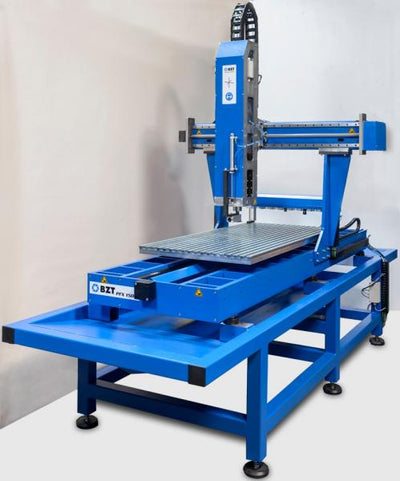
Anyone who wants to insulate in a targeted way must know what is actually making the noise. On a CNC gantry milling machine, four sources overlap:
- The machining noise: The milling cutter in the material is usually the loudest source, heavily dependent on the workpiece material, tool and cutting data. Wood and aluminium are much louder than fine plastic engraving.
- The spindle: Water-cooled HF spindles run comparatively quietly; air-cooled router motors with a fan are audibly louder, even when idling.
- The dust extraction: Often the hidden main source of noise, because it runs for the whole job, even when the milling cutter is not currently cutting.
- Structure-borne noise: Vibrations travel through the frame and floor into walls and adjacent rooms. A hood does not help against this, only decoupling does.
An enclosure works primarily against airborne noise. For a truly quiet set-up, dust extraction and installation therefore need to be part of the concept.
Materials for the Enclosure
Frame
- Aluminium extrusion profiles (e.g. 40 x 40 with slot 8): Stable, modular, easy to assemble, the best choice
- Wooden frame: Cheaper, but less stable and harder to adapt
- Steel frame: Very stable, but heavy and requires welding
Walls and Windows
- Polycarbonate (Makrolon): Transparent, impact-resistant, good noise protection, ideal for viewing windows
- Sandwich panels: Aluminium-foam-aluminium: excellent sound insulation
- MDF with acoustic foam: Low-cost solution for walls that do not need to be transparent
- Acrylic (PMMA) is not recommended, it splinters on impact
Sizing
Plan sufficient space above and around the machine:
- Height: At least 30 cm above the highest point (spindle + tool)
- Width/depth: At least 15 cm clearance from the maximum travel ranges
- Access: Large door or fold-open front for changing material
- Cable routing: Plan openings for power, controller, dust extraction and coolant
Optimising Sound Insulation: The Four Levers
1. Mass: Heavy, closed surfaces insulate better than light ones. 16 mm polycarbonate insulates noticeably better than 4 mm, and for all surfaces that do not need to be transparent, MDF or sandwich panels provide even more mass.
2. Tightness: Sound finds every gap. Fit doors and flaps with sealing tape all the way round and keep cable and hose bushings tight: a small open gap can largely cancel out the effect of thick walls.
3. Absorption: Acoustic foam or egg-crate foam on the inside prevents the sound from building up in the box and escaping through every opening. When machining metal with flying sparks, make sure to use flame-retardant materials.
4. Decoupling: Vibration dampers or rubber buffers between the machine and the floor stop structure-borne noise. The enclosure itself should not touch the machine rigidly either.
In addition there is the dust extraction: fit the extraction opening with a silencer, or enclose the extraction system as well or move it to an adjacent room. How to size the dust extraction itself is shown in the article Cyclone Separator: How It Works and Sizing.
For context: a reduction of 10 dB is perceived roughly as a halving of loudness. The realistic 15–25 dB of a well-built enclosure therefore fundamentally changes the situation in the workshop.
DIY Construction in Practice: Details That Make the Difference
- Doors: Better two smaller hinged doors than one huge flap: they warp less and seal better. Plan for all-round sealing tape and adjustable catches.
- Bushings: Route cables and the extraction hose through brush seals or tight-fitting rubber grommets instead of open cut-outs.
- Heat: Spindle, controller and frequency inverter heat up the closed box. Supply air at the bottom, exhaust air at the top, routed as a labyrinth or with sound-insulated ducts, so that the ventilation openings do not become sound bridges.
- Light and visibility: LED strips inside make the viewing window really useful; a simple camera allows process monitoring without opening the door.
- Floor and installation: A stable, heavy base absorbs vibration: wobbly tables amplify it. Where neighbours can hear the noise, also place decoupling mats under the machine feet.
Important Notes
- Fire protection: When machining metal, sparks can occur: no flammable insulation materials near the spindle
- Ventilation: When machining plastic, extract the fumes (not only chips)
- Visibility: At least one transparent window for observing the process
- Emergency stop: Must remain reachable from outside
Frequently Asked Questions
How many dB does a CNC enclosure reduce?
A well-built enclosure reduces the noise level by 15–25 dB. This means that a 90 dB machine is insulated down to 65–75 dB, comparable to a normal conversation instead of a lawnmower.
Which material is best suited for the walls?
Polycarbonate (Makrolon) in 10–16 mm thickness is ideal for viewing windows: transparent, impact-resistant and good sound insulation. For closed walls, sandwich panels or MDF with acoustic foam are the best choice.
Can I build a CNC enclosure myself?
Yes, with aluminium extrusion profiles and polycarbonate panels, building it yourself is quite feasible. Allow one to two weekends. Alternatively, there are ready-made enclosure systems that can be adapted to different machine sizes.




0 comments