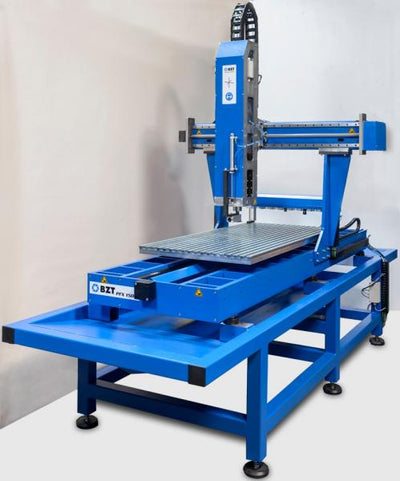
The spindle is the heart of any CNC machine. It directly determines what materials you can cut, how fast you can work, and how clean your surface finish will be. Yet spindle selection is one of the most common areas where new CNC users make costly mistakes — either under-specifying and limiting their machine's capabilities, or over-specifying and paying for power they'll never use.
This guide covers the two main spindle types used on CNC routers and portal milling machines: high-frequency (HF) spindles and router motors. We'll help you understand the differences and choose the right one for your application.
Router Motors: The Accessible Starting Point
Router motors (also called trim routers or hand router spindles) are compact, brush-type universal motors originally designed for handheld routers. Common examples include the Kress 1050 FME, AMB (formerly Kress) 1050 FME-1, and Mafell FM 1000.
Advantages:
- Low cost (200–600 EUR)
- Simple mounting with a standard 43 mm Euro collar
- No external electronics — plug in and run
- Easy to replace
- Variable speed via built-in dial (typically 10,000–29,000 RPM)
Limitations:
- Lower power (800 W–1,050 W actual cutting power)
- ER11 or ER16 collets only — limited to small tool diameters (max 8–10 mm shank)
- Higher runout (0.02–0.05 mm typical)
- Carbon brushes wear and need periodic replacement
- Louder operation (75–85 dB)
- Not designed for continuous duty — thermal limits after 30–60 minutes of heavy cutting
Router motors are a solid choice for hobbyists, light-duty workshops, and applications focused on wood, plastics, and engraving. They're also ideal for getting started with CNC before investing in a more capable spindle later.
HF Spindles: The Professional Choice
High-frequency spindles are purpose-built for CNC machines. They use brushless, asynchronous motors driven by a variable frequency drive (VFD) that controls both speed and power. The spindle shaft runs on precision ceramic or steel bearings with extremely low runout.
Advantages:
- Higher power (0.75 kW to 7+ kW)
- Precision runout (<0.005 mm on quality spindles)
- Designed for continuous duty (S1 rating)
- Significantly quieter (55–70 dB)
- Standardized tool holders (SK20, SK30, HSK, ER)
- Longer lifespan (10,000+ hours bearing life)
- Precise VFD speed control with soft start
Considerations:
- Higher cost (800–5,000+ EUR for spindle + VFD)
- Requires a separate VFD (frequency inverter)
- Water-cooled models need a cooling system
- Heavier (3–15 kg vs 1.5–2 kg for a router motor)
Air-Cooled vs Water-Cooled Spindles
HF spindles come in two cooling variants, each with distinct trade-offs:
| Feature | Air-Cooled | Water-Cooled |
|---|---|---|
| Cooling method | Built-in fan or external fins | Liquid circuit with external chiller |
| Noise level | Moderate (60–70 dB) | Very quiet (55–65 dB) |
| Complexity | Simpler setup | Requires pump, reservoir, hoses |
| Thermal stability | Good | Excellent |
| Continuous duty | Yes, but may derate at full power | Yes, full power continuous |
| Maintenance | Minimal | Coolant level, hose checks |
| Best for | General use, simpler setups | Production, metal machining, enclosed machines |
Air-cooled spindles are the most practical choice for most workshops. Water-cooled spindles are worth the extra complexity when you need sustained full-power output — for example, in production aluminum milling or long-running jobs.
Tool Holder Systems: SK20, SK30, and ER
The tool holder determines which tools you can use and how quickly you can change them:
| System | Tool Shank | Max Diameter | Tool Change | Typical Power Range |
|---|---|---|---|---|
| ER11 / ER16 | Collet | 8–10 mm | Manual (wrench) | 0.5–1.5 kW |
| ER20 / ER25 | Collet | 13–16 mm | Manual (wrench) | 1.5–3.5 kW |
| SK20 (ISO 20) | Taper + collet | 13 mm | Quick-change | 1.5–3.5 kW |
| SK30 (ISO 30) | Taper + pull stud | 20+ mm | Quick-change / ATC | 3.0–7+ kW |
| HSK-E32 / E40 | Hollow shank taper | 16–20 mm | Quick-change / ATC | 2.0–5+ kW |
SK30 is the most common professional choice for CNC portal milling machines. It offers fast tool changes (manual or automatic), accommodates a wide range of tool diameters, and is widely available from multiple tooling manufacturers. If you plan to machine aluminum regularly, SK30 should be your baseline.
Spindle Power: How Much Do You Need?
Required spindle power depends on your primary material and tool diameter:
- 0.75–1.5 kW: Wood, plastics, engraving, light aluminum (small tools only)
- 2.2–3.5 kW: Wood production, aluminum prototyping, composites, brass
- 4.5–7 kW: Production aluminum milling, large-diameter tools, heavy roughing
A common mistake is choosing a spindle based on peak material removal rate alone. Consider also: Do you need continuous duty? Will you use large-diameter tools? Do you plan to upgrade materials later? It's generally better to have some power headroom.
Major Spindle Manufacturers
For CNC routers and portal milling machines, the leading spindle manufacturers include:
- Elte (Italy) — Premium HF spindles, known for reliability and precision. Popular in the woodworking and composite industry. BZT offers Elte spindles across multiple power ratings.
- Hiteco (Italy) — Biesse subsidiary, excellent industrial HF spindles. Wide range from 1.5 to 15+ kW. Available through BZT's HF spindle collection.
- AMB (formerly Kress) (Germany) — Industry-standard router motors. The AMB 1050 FME-1 is arguably the most popular router motor in the European CNC community.
- Isel / Teknomotor — Italian-made spindles available in various configurations. Good mid-range option.
- Chinese HF spindles — Available at lower cost, but quality varies. Check runout specifications carefully and buy from reputable sellers.
Selection Decision Guide
Ask yourself these questions:
- Primary material? Wood/plastic only → router motor or 1.5 kW HF. Aluminum → 2.2 kW+ HF with SK20/SK30.
- Run time? Under 30 minutes per job → router motor is fine. Continuous production → HF spindle (S1 rated).
- Tool diameter? Only 3–8 mm tools → ER collet is sufficient. Up to 16–20 mm → SK30 needed.
- Tool changes per job? 1–2 tools → manual change is fine. 5+ tools → consider SK30 with quick-change or ATC.
- Noise sensitivity? Shared workshop or residential area → water-cooled HF spindle is significantly quieter.
For a detailed machine comparison that includes spindle options, see our CNC machine comparison page.
Summary
Router motors are affordable and simple — perfect for getting started or light-duty work. HF spindles are a step up in every performance metric: power, precision, noise, and durability. For anyone serious about CNC work, especially in metals, an HF spindle with SK30 tool holder is the professional baseline. Match the spindle to your primary application, and don't forget to factor in the cooling system, VFD, and tool holder costs when budgeting.
Frequently Asked Questions
What is the difference between an HF spindle and a router motor?
An HF (high-frequency) spindle is a brushless, precision motor designed specifically for CNC machines, driven by a variable frequency drive (VFD). A router motor is a brush-type universal motor adapted from handheld routers. HF spindles offer better precision (runout below 0.005 mm), higher power, quieter operation, and continuous duty ratings. Router motors are cheaper and simpler but have limited power, higher noise, and wear parts (carbon brushes).
Do I need a water-cooled spindle for CNC aluminum milling?
Not necessarily. Air-cooled HF spindles with 2.2 kW or more can machine aluminum effectively for most prototyping and small-batch work. Water-cooled spindles are beneficial for continuous production milling where the spindle runs at high load for extended periods. They also run quieter, which can be a factor in shared workshops. For occasional aluminum work, an air-cooled spindle is usually sufficient.
What is an SK30 tool holder and why does it matter?
SK30 (also called ISO 30 or BT30) is a standardized taper tool holder system. The tapered shank provides excellent concentricity and rigidity compared to simple ER collets. SK30 holders accommodate tool shanks up to 20 mm and allow quick tool changes — either manually with a quick-change mechanism or automatically with an ATC (automatic tool changer). This makes them ideal for multi-tool jobs and production environments.
Can I upgrade from a router motor to an HF spindle later?
Yes, most quality CNC machines — including BZT portal milling machines — are designed to accept both router motors and HF spindles via interchangeable mounting brackets. You'll need the spindle, a compatible VFD, appropriate wiring, and possibly a new Z-axis mount. Many users start with a router motor to learn CNC fundamentals, then upgrade to an HF spindle when they're ready to take on harder materials or production work.
How long does a CNC spindle last?
Quality HF spindles are rated for 10,000 to 20,000+ hours of bearing life under normal operating conditions. Actual lifespan depends on usage intensity, proper maintenance, and operating environment. Router motors have shorter lifespans due to brush wear (typically 500–1,500 hours before brush replacement). For production use, an HF spindle from a reputable manufacturer like Elte or Hiteco is the more economical choice over its lifetime.