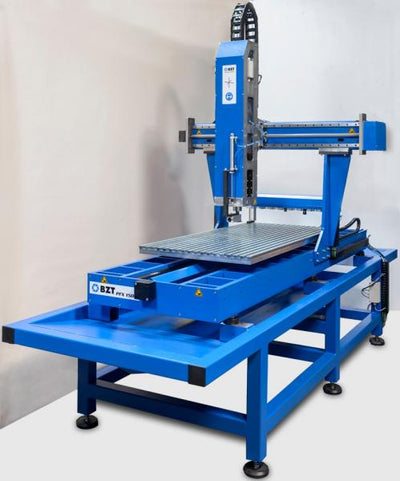
Auf Deutsch lesen: Vakuumtisch für CNC-Fräsen: Wann lohnt er sich?
Workholding — how you secure material to your CNC machine — is one of the most overlooked aspects of CNC machining. You can have the best machine, spindle, and tooling in the world, but if your workpiece moves during cutting, the result is scrap. Vacuum tables offer an elegant solution for flat sheet materials, but they're not always the right choice. This guide explains how vacuum tables work, when they make sense, and how to size your system correctly.
How a CNC Vacuum Table Works
A vacuum table uses negative air pressure to hold workpieces flat against the table surface. The basic components are:
- Vacuum table surface — A flat plate (usually phenolic, MDF, or aluminum) with a grid of channels or holes
- Gasket system — Seals that create airtight zones on the table surface
- Vacuum pump or blower — Generates the negative pressure (suction)
- Manifold and valves — Distribute vacuum and allow zone control
- Hoses and fittings — Connect everything together
When the pump runs, air is evacuated from the space between the table surface and the workpiece bottom. Atmospheric pressure (approximately 1,013 mbar or 10.13 N/cm²) then pushes the workpiece down against the table. This holding force is proportional to the sealed area — the more surface area under vacuum, the stronger the hold.
Holding Force: The Math
The theoretical holding force of a vacuum table is straightforward to calculate:
Holding force = vacuum level × sealed area
At a typical vacuum level of 800 mbar (80% of atmospheric), the holding force is approximately 8 N/cm². For a 500 × 500 mm workpiece, that's:
8 N/cm² × 2,500 cm² = 20,000 N (approximately 2,040 kg)
That sounds like plenty, but real-world performance is always lower due to:
- Leaks around gaskets and through porous materials
- Cutting forces that create lifting moments, not just lateral forces
- Reduced sealed area when parts are cut free from the sheet
- Material porosity (MDF and particle board leak significantly)
A useful rule of thumb: expect 30–60% of theoretical holding force in practice.
When to Use a Vacuum Table
Vacuum tables excel in specific scenarios:
- Sheet material processing — Plywood, MDF, acrylic, HPL, aluminum composite panels (Dibond), solid surface (Corian)
- Full-sheet nesting — When you need to cut multiple parts from a single sheet with no clamps in the way
- Thin materials — Veneers, thin plastics, and sheet metal that would distort under mechanical clamping
- High-volume production — Fast loading/unloading with no clamp setup time
- Sign making and engraving — Large panels that need full surface access
When NOT to Use a Vacuum Table
Vacuum is not the answer for every application:
- Small parts — Below approximately 100 × 100 mm, the sealed area is too small for reliable holding
- 3D parts and blocks — Vacuum needs a flat bottom surface in contact with the table
- Porous materials — Untreated wood, open-cell foam, and MDF without sealing leak too much air
- Heavy metal cutting — Aluminum milling with high side loads may exceed vacuum holding force
- Through-cutting — When you cut through the material, vacuum is lost in the cut zone (use tabbing or zone control)
For these cases, mechanical clamping (T-slot tables, step clamps, vises) remains the better choice.
Vacuum Pump Selection: Side Channel Blowers vs Vacuum Pumps
There are two main types of vacuum generators used with CNC tables:
Side Channel Blowers (Regenerative Blowers)
These are the most common choice for CNC vacuum tables. They move a high volume of air at moderate vacuum — perfect for compensating leaks from porous materials and gasket imperfections.
| Parameter | Side Channel Blower | Rotary Vane Pump |
|---|---|---|
| Airflow | 100–500 m³/h | 20–100 m³/h |
| Max vacuum | 200–350 mbar | 900–990 mbar |
| Leak tolerance | Excellent | Poor |
| Noise level | 65–80 dB | 55–70 dB |
| Maintenance | Virtually none | Oil changes, vane replacement |
| Cost | 300–1,500 EUR | 500–3,000 EUR |
| Best for | Wood, plastics, composites | Non-porous materials (acrylic, metal, HPL) |
Side channel blowers are the default recommendation for most CNC workshops. Their high airflow compensates for the inevitable leaks in real-world setups. Browse our side channel blower selection to find the right capacity for your table.
Sizing Your Side Channel Blower
The required blower capacity depends on your table size and material type:
| Table Area | Non-Porous Material | Semi-Porous (Sealed MDF) | Porous (Raw MDF/Wood) |
|---|---|---|---|
| Up to 600 × 400 mm | 50 m³/h | 100 m³/h | 200 m³/h |
| Up to 1,000 × 600 mm | 100 m³/h | 200 m³/h | 300+ m³/h |
| Up to 1,500 × 1,000 mm | 150 m³/h | 250 m³/h | 400+ m³/h |
| Up to 2,000 × 1,000 mm | 200 m³/h | 300 m³/h | 500+ m³/h |
When in doubt, size up. A blower with excess capacity simply runs at a lower vacuum level, whereas an undersized blower cannot compensate for leaks and the workpiece will lift during cutting.
Gasket Types and Setup
The gasket system is critical to vacuum table performance. Common options:
- Closed-cell foam tape — Affordable, easy to apply, but wears quickly. Good for prototyping and occasional use.
- Silicone cord gaskets — Pushed into routed channels on the table surface. Durable, reusable, and provide a reliable seal.
- O-ring cord — Similar to silicone cord but in standard O-ring cross-sections. Excellent seal quality.
- Vacuum mat / grid mat — Pre-made rubber mats with a built-in channel grid. Placed on top of a flat table surface. Fastest setup.
Pro tip: Create vacuum zones on your table using gaskets. This allows you to activate only the zones covered by your workpiece, preventing vacuum loss through uncovered areas. Even simple zone control (e.g., splitting a 1,000 × 1,000 mm table into four 500 × 500 mm zones) dramatically improves holding performance.
Material Suitability for Vacuum Holding
| Material | Vacuum Suitability | Notes |
|---|---|---|
| Acrylic (PMMA) | Excellent | Non-porous, flat, ideal for vacuum |
| HPL / Solid surface | Excellent | Corian, composite panels — perfect |
| Aluminum composite (Dibond) | Excellent | Flat, non-porous |
| Sheet aluminum | Good | Thin sheets work well; thick plate may need mechanical assist |
| Plywood (film-faced) | Good | Film face provides seal on bottom side |
| Plywood (raw) | Moderate | Some air leakage through surface — needs good blower capacity |
| MDF (sealed/painted) | Good | Paint or foil on bottom side helps seal |
| MDF (raw) | Poor to moderate | Very porous — requires high-volume blower or sealing |
| Solid wood | Poor | Too porous for reliable vacuum holding |
| Foam | Poor | Open-cell foam cannot hold vacuum at all |
Common Mistakes and How to Avoid Them
- Undersized blower — The most common mistake. If your workpiece lifts during cutting, the blower is too small or you have excessive leaks. Always size up.
- No zone control — Running vacuum over the entire table when only a small area is covered wastes suction. Use valves to close unused zones.
- Poor gasket maintenance — Worn or damaged gaskets leak. Inspect and replace regularly.
- Cutting through without tabs — When you cut a part completely free, vacuum is lost under that part. Use small holding tabs (0.5–1 mm) or onion skinning to keep parts connected.
- Ignoring spoil board flatness — Your vacuum table is only as flat as its surface. Resurface the spoil board periodically by skimming it with a large-diameter fly cutter.
Setup Tips for Best Results
- Always test vacuum hold before starting a job — place the workpiece and try to slide it by hand
- Use a vacuum gauge to monitor actual vacuum level during cutting
- For through-cuts, add tabbing (0.5 mm tabs) in your CAM software
- Seal MDF edges and bottom with shellac or tape to reduce porosity
- Keep the table surface clean — dust and chips break the seal
- Consider a combination approach: vacuum for primary hold, plus a few mechanical clamps for security
View our complete range of vacuum tables and vacuum accessories to find a system that fits your machine.
Frequently Asked Questions
How strong is a CNC vacuum table?
A vacuum table generates approximately 8 N/cm² of holding force at 800 mbar vacuum. For a 500 × 500 mm workpiece, that equals roughly 2,000 kg of theoretical holding force. In practice, expect 30–60% of the theoretical value due to leaks, material porosity, and gasket imperfections. This is more than sufficient for most routing operations in sheet materials like plywood, acrylic, and aluminum composite panels.
Can I use a vacuum table for CNC aluminum milling?
Yes, for thin aluminum sheets (up to about 3–5 mm) that cover a large area, vacuum holding works well. For thicker aluminum plate or small parts, the cutting forces may exceed the vacuum holding force, especially during heavy side-load operations. In those cases, use mechanical clamping (vise, T-slot clamps) or a combination of vacuum and mechanical hold-downs.
What size side channel blower do I need for my CNC machine?
As a general guideline, use 100–200 m³/h capacity for tables up to 600 × 400 mm, 200–300 m³/h for tables up to 1,000 × 600 mm, and 300–500 m³/h for larger tables. The required capacity depends heavily on material porosity — raw MDF needs 2–3 times more airflow than non-porous materials like acrylic. When in doubt, choose the next larger size.
Why does my workpiece lift during vacuum cutting?
The most common causes are: undersized vacuum pump/blower, air leaks through worn gaskets, uncovered table zones that waste suction, porous material without sealing, or through-cuts that break the vacuum seal under the part. Check your vacuum gauge during cutting — if vacuum drops significantly when cutting starts, you likely have a leak or capacity issue. Adding zone control valves and using tabbing for through-cuts usually solves the problem.
Is a vacuum table better than T-slot clamping?
Neither is universally better — they serve different purposes. Vacuum tables excel at holding large, flat sheet materials with no clamps obstructing the cutting path, making them ideal for nesting and sign making. T-slot clamping is better for 3D parts, small workpieces, and heavy metal machining where higher holding forces are needed at specific points. Many professional CNC setups use both: a vacuum table for sheet work and T-slot fixtures for 3D parts.