If you're exploring CNC machining for the first time, you've probably encountered two terms that seem interchangeable: CNC router and CNC mill. While both are computer-controlled cutting machines, they differ significantly in construction, capabilities, and ideal use cases. Understanding these differences is essential for choosing the right machine — and avoiding an expensive mistake.
What Is a CNC Router?
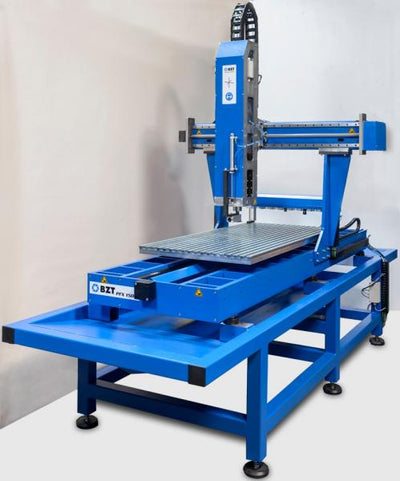
A CNC router is a computer-controlled cutting machine designed primarily for processing large, flat sheet materials. Think wood panels, MDF, acrylic sheets, composite materials, and aluminum sheets. CNC routers typically feature a gantry-style construction where the cutting head moves on a bridge that spans the work area.
Key characteristics of CNC routers:
- Large work envelopes — commonly 1,000 × 1,000 mm up to 3,000 × 2,000 mm or larger
- Gantry (portal) construction for maximum accessibility
- High-frequency (HF) spindles running at 18,000–24,000 RPM
- Rapid traverse speeds of 15,000–30,000 mm/min
- Optimized for 2D profiling, pocketing, and 2.5D operations
- Often equipped with vacuum tables for sheet material clamping
What Is a CNC Mill?
A CNC mill (or CNC milling machine) is built for precision metalworking. Traditional CNC mills use a column-and-knee or bed-type construction with the spindle mounted vertically (or horizontally) above a moving table. They prioritize rigidity and cutting force over speed and work area.
Key characteristics of CNC mills:
- Smaller work envelopes — typically 300 × 300 mm to 1,000 × 500 mm
- Column or C-frame construction for maximum rigidity
- Spindle speeds of 3,000–12,000 RPM (some HSC spindles reach 40,000+ RPM)
- Lower rapid traverse speeds but higher cutting forces
- Designed for full 3D machining, including hard metals like steel and titanium
- T-slot tables with mechanical clamping (vises, clamps)
Construction: Gantry vs Column
The most visible difference is the machine architecture:
| Feature | CNC Router (Gantry) | CNC Mill (Column) |
|---|---|---|
| Frame type | Portal/gantry bridge | Column or C-frame |
| Moving element | Gantry moves over stationary table | Table moves under stationary spindle |
| Accessibility | Full top access to work area | Limited by column and enclosure |
| Rigidity | Good (depends on build quality) | Excellent (compact, heavy) |
| Typical weight | 200–2,000 kg | 500–10,000 kg |
| Scalability | Easy to scale up work area | Limited by column height/reach |
Gantry construction is inherently scalable — you can build a portal bridge over a 3-meter-wide table without fundamentally changing the design. Column mills, however, become impractical beyond a certain size because the column would need to be enormous.
Spindle Differences
CNC routers typically use high-frequency (HF) spindles that run at high RPM with relatively low torque. These are ideal for the light, fast cuts required in wood and plastics. Common power ratings range from 1.5 kW to 7 kW.
CNC mills use gear-driven or direct-drive spindles with higher torque at lower RPM. This is necessary for removing material from hard metals where cutting forces are significant.
However, this distinction is increasingly blurred. Modern HF spindles in the 3.5–7 kW range, especially with SK30 tool holders, can machine aluminum and even mild steel effectively when paired with a rigid machine frame.
Material Capabilities
| Material | CNC Router | CNC Mill |
|---|---|---|
| Wood, MDF, plywood | Excellent | Possible but overkill |
| Plastics, acrylic, Corian | Excellent | Good |
| Foam, composites | Excellent | Possible |
| Aluminum (soft alloys) | Good to excellent | Excellent |
| Brass, copper | Good (with right spindle) | Excellent |
| Mild steel | Limited | Excellent |
| Hardened steel, titanium | Not recommended | Required |
When to Choose a CNC Router
A CNC router is the better choice when:
- You primarily work with wood, plastics, composites, or sheet aluminum
- You need a large work area (1,000 mm+ in X and Y)
- Fast material removal and high traverse speeds matter
- You process full-size sheet materials (e.g., 2,440 × 1,220 mm panels)
- Your applications include sign making, furniture production, prototyping, or model making
When to Choose a CNC Mill
A CNC mill is the better choice when:
- You primarily machine steel, stainless steel, or other hard metals
- Dimensional accuracy below ±0.01 mm is critical
- You need high cutting forces for deep slotting or heavy roughing
- Your parts are relatively small (under 500 mm)
- You work in tool and die making, aerospace, or medical parts manufacturing
The Hybrid: CNC Portal Milling Machines
There's a third category that combines the best of both worlds: CNC portal milling machines (also called gantry mills). These machines use gantry construction for a large work area but are built with the rigidity needed for metal machining.
At BZT Maschinenbau, we've been building CNC portal milling machines since 2006. Our machines use Bosch Rexroth linear guides, solid aluminum-steel hybrid frames, and HF spindles up to 7 kW — giving you a router's work area with a mill's material capabilities.
A well-built portal milling machine can:
- Machine aluminum at production-level feeds and speeds
- Process wood and plastics at high speed
- Handle brass, copper, and even mild steel with appropriate spindles
- Offer work areas from 300 × 400 mm up to 3,000 × 2,010 mm
If your work spans multiple material types — for example, prototyping in wood before cutting final parts from aluminum — a portal milling machine is often the most versatile single investment. Explore our full range of CNC machines or use our CNC buying guide to find the right fit.
Summary
CNC routers and CNC mills serve different primary purposes. Routers excel at large-format, high-speed work in softer materials. Mills excel at precision metalwork in smaller envelopes. Portal milling machines bridge the gap. Choose based on your primary material and part size — and don't underestimate the versatility of a well-built gantry machine.
Frequently Asked Questions
Can a CNC router cut metal?
Yes, many CNC routers can cut soft metals like aluminum, brass, and copper — especially machines with rigid frames and HF spindles rated at 2.2 kW or above. However, CNC routers are generally not suitable for steel or other hard metals. For aluminum, use single-flute or polished two-flute end mills with appropriate feeds, speeds, and minimum quantity lubrication (MQL).
What is the main advantage of a CNC router over a CNC mill?
The main advantage is work area size. CNC routers with gantry construction can offer work areas of 2,000 × 1,000 mm or larger while remaining accessible from all sides. A CNC mill with the same work area would be impractically large and expensive. If you process sheet materials or large parts, a router is typically the better choice.
Is a CNC portal milling machine the same as a CNC router?
Not exactly. A CNC portal milling machine (gantry mill) uses the same gantry construction as a router but is typically built with heavier frames, precision linear guides, and more powerful spindles. This makes it capable of machining metals like aluminum at production speeds — something that basic CNC routers struggle with. Portal milling machines are a hybrid between routers and mills.
How much does a CNC router cost compared to a CNC mill?
Entry-level hobby CNC routers start around 2,000–5,000 EUR, while professional CNC routers range from 8,000 to 50,000+ EUR depending on size and features. CNC mills typically start at 15,000 EUR for small benchtop models and can exceed 200,000 EUR for production machines. Professional CNC portal milling machines like those from BZT fall in the 5,000–25,000 EUR range, offering excellent value for multi-material workshops.
Can I use a CNC router for 3D carving?
Yes. CNC routers with 3-axis control can perform 3D carving and contouring using ball-nose end mills. The quality depends on the machine's rigidity, spindle runout, and the CAM software used. For detailed 3D work in wood, foam, or modeling board, CNC routers are an excellent choice. Some machines also support a 4th rotary axis for cylindrical work.