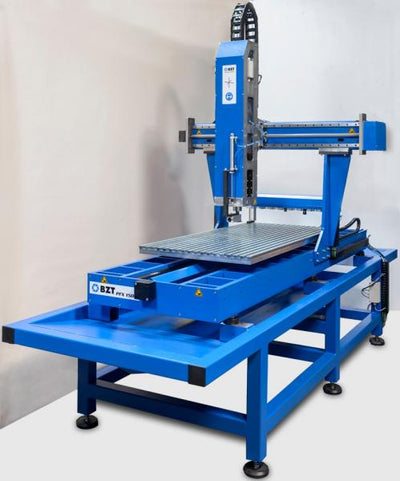
Aluminum is the gateway metal for CNC routing. It machines cleanly, is widely available, and produces impressive results when done right. But it's also the material that humbles the most beginners — with broken tools, melted cuts, and chattering nightmares. This guide walks you through everything you need to know to successfully mill aluminum on a CNC router or portal milling machine.
Why Aluminum?
Aluminum is the most popular metal for CNC machining for good reasons:
- Excellent machinability — Soft enough for high-speed routing, hard enough for functional parts
- High strength-to-weight ratio — Ideal for aerospace, automotive, and structural applications
- Good thermal conductivity — Helps dissipate cutting heat (with proper chip evacuation)
- Corrosion resistant — Natural oxide layer provides protection
- Widely available — Stock in plate, sheet, bar, and extrusion profiles
- Recyclable — Aluminum chips have real scrap value
Aluminum Alloy Types for CNC
Not all aluminum is created equal. The alloy significantly affects machinability:
| Alloy | Common Name | Machinability | Typical Use |
|---|---|---|---|
| 6061-T6 | The "standard" | Excellent | General purpose, prototypes, fixtures, structural parts |
| 6082-T6 | European 6061 | Excellent | Same as 6061, more common in Europe |
| 7075-T6 | Aircraft aluminum | Good | High-stress parts, aerospace, tooling |
| 5083 | Marine aluminum | Moderate | Marine, chemical exposure applications |
| 2024-T3 | Aerospace | Good | Aircraft structures, high-fatigue applications |
| AlMg3 (5754) | Soft aluminum | Moderate (gummy) | Formed parts, sheet metal |
Start with 6061-T6 or 6082-T6. These alloys produce clean chips, have predictable cutting behavior, and are forgiving of less-than-perfect parameters. Avoid 5000-series alloys (AlMg) as your first aluminum — they tend to be "gummy" and produce long, stringy chips that wrap around the tool.
Tool Selection
Tool choice is critical for aluminum. The wrong end mill will produce poor results regardless of your feeds and speeds.
Single-Flute End Mills
Single-flute (or "O-flute") end mills are the top recommendation for CNC routers and portal mills cutting aluminum. Why?
- Maximum chip clearance — the single flute leaves a large evacuation channel
- Higher effective chip load per tooth at any given feed rate
- Less heat buildup from chip re-cutting
- Works well at the high RPM typical of HF spindles (18,000–24,000 RPM)
Two-Flute Polished End Mills
Polished (mirror-finish) two-flute end mills with sharp edges and low-friction coatings are another excellent option. The polished surfaces prevent aluminum from welding to the tool. Look for:
- Polished flute surfaces (not standard coated)
- Positive rake angle (35° or higher)
- ZrN (zirconium nitride) or DLC (diamond-like carbon) coating
- Sharp cutting edges — never use worn tools in aluminum
What to Avoid
- 3+ flute end mills — Insufficient chip clearance at router RPM speeds. Chips pack the flutes, generate heat, and the tool welds up.
- Standard TiN/TiAlN coated tools — These coatings are designed for steel and have high aluminum affinity. The coating actually makes aluminum stick more.
- Dull or chipped tools — Aluminum does not tolerate dull edges. Dull tools generate heat instead of cutting, leading to material welding on the tool.
Feeds and Speeds
Getting feeds and speeds right is the single most important factor in aluminum milling. The core principle: each tooth must take a real chip. Too-thin chips rub instead of cutting, generating heat that melts the aluminum onto the tool.
Key Parameters
- Chip load (fz) — Material removed per tooth per revolution. For aluminum: 0.05–0.15 mm/tooth for finishing, 0.10–0.25 mm/tooth for roughing.
- Spindle speed (n) — RPM. Depends on tool diameter and desired surface speed.
- Feed rate (vf) — Calculated: vf = n × z × fz (RPM × flutes × chip load)
- Depth of cut (ap) — Axial depth. Start conservative: 1× tool diameter max for slotting, 2–3× for adaptive/trochoidal.
- Width of cut (ae) — Radial engagement. For adaptive toolpaths: 10–20% of tool diameter.
Starter Feeds and Speeds Table
These values assume a rigid CNC portal milling machine with HF spindle. Adjust down 20–30% for lighter machines:
| Tool Diameter | Flutes | RPM | Chip Load (fz) | Feed Rate (vf) | DOC (ap) | WOC (ae) |
|---|---|---|---|---|---|---|
| 3 mm | 1 | 24,000 | 0.06 mm | 1,440 mm/min | 3 mm | 0.6 mm |
| 4 mm | 1 | 24,000 | 0.08 mm | 1,920 mm/min | 4 mm | 0.8 mm |
| 6 mm | 1 | 24,000 | 0.10 mm | 2,400 mm/min | 6 mm | 1.2 mm |
| 6 mm | 2 | 20,000 | 0.08 mm | 3,200 mm/min | 6 mm | 1.2 mm |
| 8 mm | 1 | 18,000 | 0.12 mm | 2,160 mm/min | 8 mm | 1.6 mm |
| 10 mm | 2 | 18,000 | 0.10 mm | 3,600 mm/min | 10 mm | 2.0 mm |
| 12 mm | 2 | 16,000 | 0.10 mm | 3,200 mm/min | 12 mm | 2.4 mm |
These are conservative starting parameters for adaptive/trochoidal toolpaths (10–20% radial engagement). For conventional slotting (100% radial engagement), reduce depth of cut to 0.5–1× tool diameter and feed rate by 40–50%.
Cooling and Lubrication
Aluminum machining generates significant heat. Without proper cooling strategy, you'll experience:
- Aluminum welding to the tool (built-up edge, or BUE)
- Poor surface finish with torn rather than cut surfaces
- Rapid tool wear
- Workpiece overheating and dimensional inaccuracy
Minimum Quantity Lubrication (MQL)
MQL is the recommended cooling method for CNC routers and portal milling machines. A small amount of oil (typically 5–50 ml/h) is atomized with compressed air and directed at the cutting zone. Benefits:
- Dramatically reduces aluminum adhesion to the tool
- No flood coolant to manage, filter, or dispose of
- Keeps the workpiece and chips relatively dry
- Cost-effective — a liter of MQL oil lasts weeks
Explore our lubrication and cooling solutions for MQL systems compatible with BZT machines.
Compressed Air Blast
At minimum, direct a compressed air stream at the cutting zone to evacuate chips. Chip re-cutting is the primary cause of tool failure in aluminum milling — the tool re-cuts hot chips, they weld to the tool, and cutting forces spike until something breaks.
Chip Evacuation: The Overlooked Factor
Chip evacuation is arguably more important than cooling in aluminum milling. Hot aluminum chips that stay in the cut will re-weld to the tool or workpiece. Ensure:
- Air blast or dust extraction is aimed at the cutting zone
- Single-flute tools provide natural chip clearance
- Climb milling (not conventional) ejects chips behind the tool's path
- Adaptive toolpaths keep radial engagement low, giving chips room to exit
Toolpath Strategies
Modern CAM software offers toolpath strategies that make aluminum milling safer and more efficient:
- Adaptive / trochoidal milling — Maintains constant tool engagement regardless of geometry. This is the single best strategy for aluminum on CNC routers. Use it whenever possible.
- Ramp entry — Never plunge straight into aluminum. Use ramping (linear or helical) at 1–2° to gradually enter the material.
- Climb milling — Always use climb milling (tool rotation and feed direction match) for better chip evacuation and surface finish.
- Finishing passes — Take a separate light finishing pass (0.1–0.3 mm radial stock) at higher feed rate and full depth for clean walls.
Common Mistakes
1. Chip Load Too Low (Rubbing Instead of Cutting)
The most common beginner mistake. Running too slow a feed rate at high RPM means each tooth takes a micro-thin chip that generates heat instead of removing material. Solution: Use the feeds and speeds table above as a starting point and adjust from there. Listen to the cut — a good aluminum cut sounds like a steady hum, not a scream or squeal.
2. No Lubrication
Dry cutting in aluminum works at light loads but fails at production parameters. Even a manual spray of isopropyl alcohol or WD-40 is better than nothing. Solution: Invest in an MQL system — they start at under 200 EUR and transform your aluminum cutting capability.
3. Using the Wrong Tool
Standard 3-flute steel-cutting end mills will pack with chips in seconds when used in aluminum at router RPMs. Solution: Use single-flute or polished two-flute end mills designed specifically for aluminum and non-ferrous metals.
4. Ignoring Chip Buildup
Aluminum chips that accumulate in pockets or slots get re-cut, generating extreme heat. Solution: Program pecking cycles for deep pockets, use chip-breaking toolpaths, and always have air blast or extraction running.
5. Full-Width Slotting
Cutting a slot at full tool diameter (100% radial engagement) is extremely demanding. Both flute edges are engaged simultaneously, chip evacuation is blocked, and heat builds rapidly. Solution: Use adaptive toolpaths with 10–20% radial engagement and full depth of cut instead. Material removal rate is often higher than slotting, with far less tool stress.
Getting Started
If you're new to aluminum CNC milling, here's a practical sequence:
- Get a single-flute end mill in 6 mm diameter (carbide, polished or uncoated)
- Get a piece of 6061-T6 or 6082-T6 plate, 10 mm thick
- Set up MQL or at minimum a compressed air blast
- Program a simple adaptive pocket using the 6 mm parameters from the table above
- Run at 80% of the listed feed rate and listen
- Examine the chips — they should be small, comma-shaped, and not discolored (blue/brown means too much heat)
- Gradually increase feed rate until chip formation looks right
With the right setup, even a mid-range CNC portal milling machine can produce excellent results in aluminum. Browse our CNC machines and cutting tools to get started.
Frequently Asked Questions
Can a CNC router mill aluminum?
Yes. CNC routers and portal milling machines with rigid frames and HF spindles (2.2 kW or above) can mill aluminum effectively. The key requirements are: proper cutting tools (single-flute or polished two-flute), correct feeds and speeds, lubrication (MQL recommended), and good chip evacuation. Alloys like 6061-T6 and 6082-T6 are the easiest to machine on router-class equipment.
What is the best end mill for CNC aluminum milling?
For CNC routers running at 18,000–24,000 RPM, single-flute carbide end mills are the best all-around choice. They provide maximum chip clearance, preventing the packed-flute failures common with multi-flute tools at high RPM. Polished two-flute end mills with ZrN or DLC coating are a close second, offering better surface finish at slightly higher feed rates. Avoid 3+ flute end mills and standard TiN/TiAlN coatings.
What feed rate should I use for CNC aluminum?
Feed rate depends on tool diameter, number of flutes, and RPM. The key parameter is chip load (fz): aim for 0.05–0.15 mm/tooth for finishing and 0.10–0.25 mm/tooth for roughing in 6061/6082 aluminum. For example, a 6 mm single-flute at 24,000 RPM with 0.10 mm chip load gives a feed rate of 2,400 mm/min. Too slow is worse than slightly too fast — insufficient chip load causes rubbing and heat buildup.
Do I need coolant for CNC aluminum milling?
Lubrication is highly recommended. Minimum Quantity Lubrication (MQL) is the best solution for CNC routers — it delivers a fine oil mist to the cutting zone, prevents aluminum from welding to the tool, and keeps the machine clean compared to flood coolant. At absolute minimum, use compressed air to blow chips from the cut. Dry cutting works only at very conservative parameters and short run times.
Why is my aluminum melting during CNC milling?
Aluminum "melting" (actually re-welding onto the tool and workpiece) is caused by excessive heat in the cutting zone. The usual causes are: chip load too low (rubbing instead of cutting), no lubrication, poor chip evacuation (re-cutting hot chips), dull tool, or using a tool with too many flutes that pack with chips. Fix it by increasing feed rate, adding MQL, ensuring chip evacuation with air blast, and using a sharp single-flute end mill.