

Plastics are versatile, lightweight and easy to machine, at least in theory. In practice it quickly becomes clear that every plastic has its own temperament. While some materials cut like butter, others tend to melt, splinter or warp.
Why Plastics Are Different from Metal
Before we go into the details, it is important to understand why plastics require special attention:
- Low thermal conductivity: The heat generated cannot dissipate, so the material melts
- Low melting points: Many plastics soften at as little as 80–150 °C
- Elasticity: The material yields instead of being cut
- Electrostatic charging: Chips stick everywhere
- Stress sensitivity: Excessive clamping force deforms the workpiece
The Most Important Types of Plastic in Detail
PMMA (Acrylic/Plexiglas)
PMMA is one of the most popular plastics for CNC machining: optically brilliant, UV-resistant and excellent for polishing.
Properties:
- Glass-clear finish possible
- Prone to scratching
- Brittle, and can crack if the parameters are wrong
- Melts with too much heat (from approx. 100 °C)
Machining tips:
- Single-flute end mills (solid carbide) for better chip removal
- High spindle speeds (18,000–24,000 rpm) AND high feed rates (2000–4000 mm/min)
- No sudden changes of direction: round off the corners
- Never let the tool dwell in the material (heat build-up)
- Remove the protective film only after machining
POM (Polyoxymethylene/Delrin/Hostaform)
POM is the engineering plastic par excellence: self-lubricating, dimensionally stable and outstandingly machinable.
Properties:
- Self-lubricating: ideal for plain bearings
- Very good dimensional accuracy
- High rigidity and strength
- FDA-compliant (food-safe)
The ideal candidate: POM is forgiving. It does not melt as easily as PMMA and does not splinter.
Machining tips:
- Standard solid carbide milling cutters work well
- Moderate spindle speeds (15,000–20,000 rpm)
- Cooling is usually not necessary
- Excellent surfaces possible
PA (Polyamide/Nylon)
PA is tough and elastic, which becomes a challenge when milling: the material yields instead of being cut cleanly.
Properties:
- Very tough and wear-resistant
- Absorbs moisture (swells)
- Good sliding properties
Machining tips:
- Very sharp tools with a positive rake angle
- High feed rates: the material must be cut, not pushed
- Store the material dry before machining
- Compressed air for cooling and chip removal
PE (Polyethylene) and PP (Polypropylene)
These commodity plastics are soft, tough and tend to melt.
Machining tips:
- Very sharp tools are essential
- High feed rates, low depth of cut
- Compressed-air cooling recommended
- Downcut milling cutters prevent the material from lifting
Rigid PVC
Stiffer than PE/PP, but take care: at excessively high temperatures, toxic fumes (chlorine gas) are produced.
Machining tips:
- Good dust extraction is mandatory (fumes)
- Moderate parameters: do not overheat
- Ventilate the room well
PC (Polycarbonate/Makrolon)
Extremely impact-resistant and transparent, but demanding to machine.
Machining tips:
- Similar to PMMA, but even more sensitive to heat
- Prone to stress cracking, so clamp carefully
- Do not use aggressive coolants
Parameter Overview
| Material | Spindle speed | Feed rate | Depth of cut | Notes |
|---|---|---|---|---|
| PMMA | 18,000–24,000 | 2000–4000 mm/min | 50% of cutter Ø | Do not dwell in the material |
| POM | 15,000–20,000 | 1500–3000 mm/min | 50–70% of cutter Ø | Very forgiving |
| PA | 15,000–20,000 | 2000–3500 mm/min | 40–50% of cutter Ø | Use sharp tools |
| PE/PP | 12,000–18,000 | 2500–4000 mm/min | 30–50% of cutter Ø | Compressed-air cooling |
| Rigid PVC | 15,000–20,000 | 1500–2500 mm/min | 40–50% of cutter Ø | Dust extraction is mandatory |
| PC | 16,000–22,000 | 1500–3000 mm/min | 40–50% of cutter Ø | Watch for stress cracks |
The Right Tools for Plastic
Cutter Geometry
Milling cutters for plastic differ significantly from metal-cutting tools:
- Larger rake angles: Reduce friction and heat generation
- Polished flutes: Chips slide off better, less frictional heat
- Single-flute end mills preferred: More space for chips, better removal
- Sharp cutting edges: Blunt tools cause melting
Recommended Cutter Types
| Cutter type | Application | Plastics |
|---|---|---|
| Polished solid carbide single-flute end mill | Universal, contours, pockets | All, especially PMMA |
| Single-flute end mill, plastics geometry | Soft plastics | PE, PP, PA |
| Polished two-flute end mill | Finishing, fine surfaces | POM, PC |
| V-groove cutter | Engraving | All |
Cooling for Plastics
Unlike with metal, liquid cooling is often counterproductive with plastics:
- Some coolants cause stress cracks (especially with PC)
- Water can be absorbed by PA
- Residues on the surface
Better suited:
- Compressed air: Cools by expansion and blows chips away
- No cooling at all: Sufficient for many plastics if the parameters are right
Typical Problems and Solutions
| Problem | Cause | Solution |
|---|---|---|
| Material melts | Too slow, cutter blunt | Increase feed rate, new cutter |
| Chips stick to the cutter | Too much heat, wrong tool | Polished flute, compressed air |
| Cracks in the material (PMMA) | Impact load, stress cracks | Clamp more gently, adjust parameters |
| Rough edges (PA) | Material yields | Sharper tool, higher feed rate |
| Workpiece warped | Excessive clamping force, heat input | Less clamping force, better cooling |
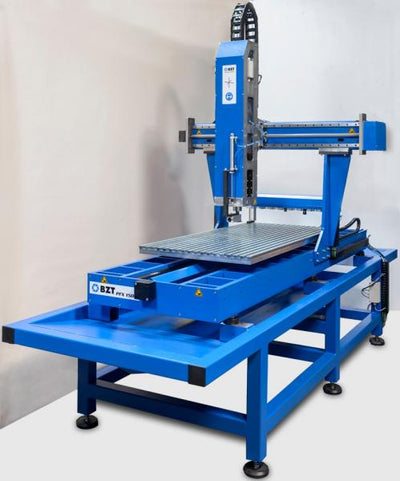
Recommended BZT Machines
- PFE series: Protected Y axis beneath the T-slot table, so chips do not get into the guides
- PFU-S series: Robust and versatile for all plastics
- Vacuum table option: Ideal for sheet material
FAQ: Frequently Asked Questions
Which plastic is easiest to mill?
POM (Delrin) is the most rewarding plastic to work with: it forgives parameter errors, does not melt easily and delivers excellent surfaces.
Can I mill plastic with metal-cutting tools?
Yes, but not ideally. It works for occasional jobs; for regular machining, dedicated plastics milling cutters are worthwhile.
Why is my PMMA melting?
Either the feed rate is too low, the milling cutter is blunt, or you are dwelling in the material. Increase the feed rate significantly.
Conclusion: Plastic requires adjustment
Plastic is not an easier material than metal, just a different one. With the right tools, adjusted parameters and an understanding of the material properties, you will achieve professional results.
Do you have questions about plastics machining? Our technical team will be happy to advise you.




0 comments