

In modern manufacturing, two technologies take centre stage: CNC milling and 3D printing. Both have their place, but they solve fundamentally different problems. This comprehensive comparison helps you decide which process is right for your specific project, or whether you need both.
Understanding the Basic Principles
CNC Milling: Subtractive Manufacturing
With CNC milling, you start with a solid block of material: wood, aluminium, plastic or even steel. A rotating tool removes material in a controlled way until the desired part remains.
- Principle: Removing material (subtractive)
- Analogy: A sculptor chiselling a sculpture out of marble
- Result: Part made of solid, homogeneous material
3D Printing: Additive Manufacturing
With 3D printing (usually FDM, SLA or SLS), the component is built up layer by layer. Material is placed only where it is needed.
- Principle: Adding material (additive)
- Analogy: A bricklayer laying brick upon brick
- Result: Part made of stacked layers
The Big Comparison: All Important Criteria
| Criterion | CNC milling | 3D printing (FDM) |
|---|---|---|
| Material variety | Excellent: Metals, wood, plastics, composites, foams | Limited: Mainly thermoplastics (PLA, PETG, ABS, nylon) |
| Precision | Very high: 0.01–0.05 mm achievable | Good: 0.1–0.2 mm typical |
| Surface quality | Excellent: Smooth, professional surfaces | Visible layer lines without finishing |
| Strength | Homogeneous in all directions (isotropic) | Weak between layers (anisotropic) |
| Geometric freedom | Limited: The tool must have access | Very high: Cavities and undercuts possible |
| Speed | Fast for large amounts of material | Slow: Hours to days per part |
| Material waste | Higher: Chips as a by-product | Minimal: Only support structures |
| Unit cost in series production | Falls sharply with quantity | Remains constant per part |
| Investment cost | Medium to high | Low to medium |
When CNC Milling Is the Better Choice
1. Functional Metal Parts
If your part has to bear mechanical loads, there is no way around a CNC milling machine. Aluminium, brass or steel offer strengths that no plastic 3D printing can achieve.
Examples:
- Machine brackets and adapters
- Gears and drive elements
- Housings for electronics
- Precision parts with tight tolerances
2. Large Surfaces and Sheet Machining
A gantry milling machine can machine large sheets efficiently, something a 3D printer would need days for.
Examples:
- Furniture parts made of wood or MDF
- Signs and front panels
- Nesting jobs (many parts from one sheet)
- Large-scale architectural models
3. High-Quality Surfaces
Milled surfaces can look high-quality straight after machining, without rework. With 3D prints, layer lines are visible.
Examples:
- Visible parts made of aluminium
- Wooden parts with natural grain
- Engravings and lettering
- Acrylic parts with polishable edges
4. Series Production
For quantities of 10–20 parts or more, CNC milling is almost always more economical. The setup time is spread across the parts, and the production time per part is shorter.
5. Real Materials
CNC milling works with the same materials that are used in the end product. A milled aluminium part behaves exactly like aluminium, because it is aluminium.
When 3D Printing Is the Better Choice
1. Complex Internal Geometries
A milling cutter can only go where it has room. Cavities, undercuts and organic shapes are no problem for 3D printing.
Examples:
- Cooling channels in components
- Organic structures (bionic design)
- Complex housings with snap-fits
- Parts with internal cavities for weight saving
2. Rapid Concept Validation
To test whether a design fits and works, a 3D print from inexpensive PLA is unbeatably fast and cheap.
3. One-Offs and Prototypes
With a batch size of one, 3D printing needs no setup time at all. You load the file, press start and collect the part the next morning.
4. Very Small, Filigree Parts
3D printing can have advantages with tiny parts: no clamping, no tool wear on miniature milling cutters.
The Economic Perspective
Cost Comparison: An Example
Let us take a simple housing (100 x 100 x 30 mm):
| Factor | CNC from aluminium | 3D printing (PETG) |
|---|---|---|
| Material cost | approx. €15 (aluminium block) | approx. €3 (filament) |
| Production time | approx. 30 min | approx. 8 hours |
| Machine cost per hour | approx. €25 | approx. €2 |
| Total cost, 1 piece | approx. €28 | approx. €19 |
| Total cost, 10 pieces | approx. €180 | approx. €190 |
| Total cost, 100 pieces | approx. €1,200 | approx. €1,900 |
Insight: For small quantities, 3D printing can be cheaper. Beyond a certain quantity, the calculation tips in favour of CNC milling, and you get a higher-quality product.
Break-Even Point
The point at which CNC becomes more economical depends on many factors:
- Part geometry and size
- Desired material
- Quality requirements
- Available machine capacity
As a rule of thumb: from 5–20 identical parts, CNC production is often worthwhile.
The Dream Team: Combining Both Processes
Professional workshops have both machines, and they complement each other perfectly:
Typical Workflow
- Design: Create a CAD model (e.g. in Fusion 360)
- Prototype: 3D print overnight, hold it in your hand in the morning
- Validation: Does it fit? Does it work? Does it look good?
- Iteration: Adjust the design if necessary, print again
- Production: Make the final part on the CNC milling machine from the target material
Hybrid Components
Sometimes it makes sense to combine both processes in one part:
- Milled base: Stable, precise basic structure made of aluminium
- Printed additions: Complex attachments, cable guides, clips
Material Comparison in Detail
| Material | CNC milling | 3D printing |
|---|---|---|
| Aluminium | Excellent | Not possible (without metal sintering) |
| Steel | Possible (with the right machine) | Metal sintering only (very expensive) |
| Wood | Excellent | Not possible |
| PMMA (acrylic) | Excellent, polishable | Possible, but poorer optics |
| POM (Delrin) | Excellent | Difficult to print |
| PA (nylon) | Good | Good (with dry box) |
| Flexible parts | Limited | Good (TPU filament) |
| Carbon/GRP | Possible (dust extraction essential) | Only as a filament additive |
Avoiding Typical Mistakes
Mistake 1: Forcing the Wrong Process
Not every problem is a nail just because you have a hammer. Choose the process according to the requirements, not according to the machine available.
Mistake 2: Overestimating the Strength of 3D Prints
3D-printed parts have a weak point between the layers. For mechanically loaded parts, milled solid plastic or metal is often the better choice.
Mistake 3: Underestimating Finishing
3D prints often need considerable finishing (sanding, painting) to look professional. Milled parts are often ready for use straight away.
Recommended BZT Machines
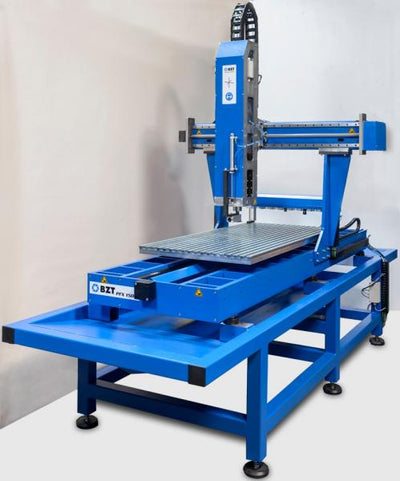
Our gantry milling machines are ideal for anyone who wants to machine real materials precisely:
- PFK series: Compact for small workshops
- PFE series: Versatile for wood, plastic and aluminium
- PFU-S series: Robust for regular use
- PFH series: Industrial performance for metal
FAQ: Frequently Asked Questions
Is CNC milling harder to learn than 3D printing?
Yes, somewhat. With 3D printing, the slicer does a lot of the work. With milling, you have to understand tools, clamping and CAM strategies. But the learning curve is worth it for the professional results and the variety of materials.
Can a CNC milling machine also print?
There are hybrid approaches with print heads on CNC machines, but specialised machines are better. A rigid milling machine is designed for cutting forces, a printer for light, fast movements.
Which software do I need for both processes?
For both, you start with a 3D CAD model (e.g. Fusion 360, FreeCAD). For the printer, you export an STL file for the slicer. For the milling machine, you create G-code with toolpaths in the CAM module.
Is a CNC milling machine worthwhile if I already have a 3D printer?
If you are struggling with the limitations of 3D printing (strength, surfaces, materials), then definitely yes. The machines complement each other perfectly.
Conclusion: No Either-Or
CNC milling and 3D printing are not competitors. They are tools for different tasks:
- CNC milling: When precision, strength, surface finish and real materials matter
- 3D printing: When complex geometries, rapid iteration or one-offs are required
The question is not “either/or” but “which one when”. And often the best answer is: both.
Related Guides
Would you like to machine real materials precisely? Take a look at our gantry milling machines, Made in Germany for professional results.



0 comments